VAT on commercial rent in Switzerland: who pays in 2026

At a glance
Renting business premises is exempt from VAT in Switzerland. If the landlord is VAT-registered, though, they can choose to charge VAT on any lease they like, as long as you do not use the space only as a home. You then pay 8.1% on rent and ancillary costs. If you are VAT-registered and make taxable supplies, you get it back as input tax. For everyone else, the option is a rent increase.
In francs: with CHF 4,000 rent and CHF 400 ancillary costs a month, that is CHF 356.40 of VAT a month, or CHF 4,276.80 a year. For an accounting firm that uses the effective method and makes only taxable supplies, it costs nothing in the end. For a physiotherapy practice, whose treatments are exempt from VAT, it comes to CHF 42,768 over ten years at today's rate. We go through the option from the tenant's side, with the rules of the Federal Tax Administration (FTA), the deadlines from tenancy law and a clause you can put into your lease.
What is the VAT option?
The option is the landlord's right to charge VAT on a supply that the law otherwise exempts. Letting land and buildings, or parts of them, is exempt (Art. 21 para. 2 no. 21 VAT Act). A VAT-registered landlord can still tax it, either by showing the VAT openly or by declaring the turnover in their VAT return (Art. 22 VAT Act). The option is ruled out only if you use, or intend to use, the space exclusively as a home.
How the FTA applies this is set out in its VAT industry information on real estate, MWST-Branchen-Info 17, published in German, French and Italian. Three points in it matter for tenants. First, it makes no difference whether you are VAT-registered yourself: the landlord can opt even when renting to a small business without a VAT number. Second, the landlord decides lease by lease. In the same building, your neighbour can rent without VAT and you with it. Third, "exclusively as a home" is tested per lease. If someone rents three floors under one lease, two to live in and one half used as an office, the landlord can opt. There is then no input tax deduction on the residential share.
Only the party letting the space can opt: the owner, the landlord or a tenant who sublets. A landlord who reports at a net tax rate cannot opt for the rent (VAT Info 12, section 12.1). Showing the VAT in the lease is enough to exercise the option. The FTA accepts that a lease can count as an invoice, and a line such as "plus 8.1% VAT" (in a German lease, «zuzüglich 8,1 % MWST») does the job. This is how the money then flows every month:
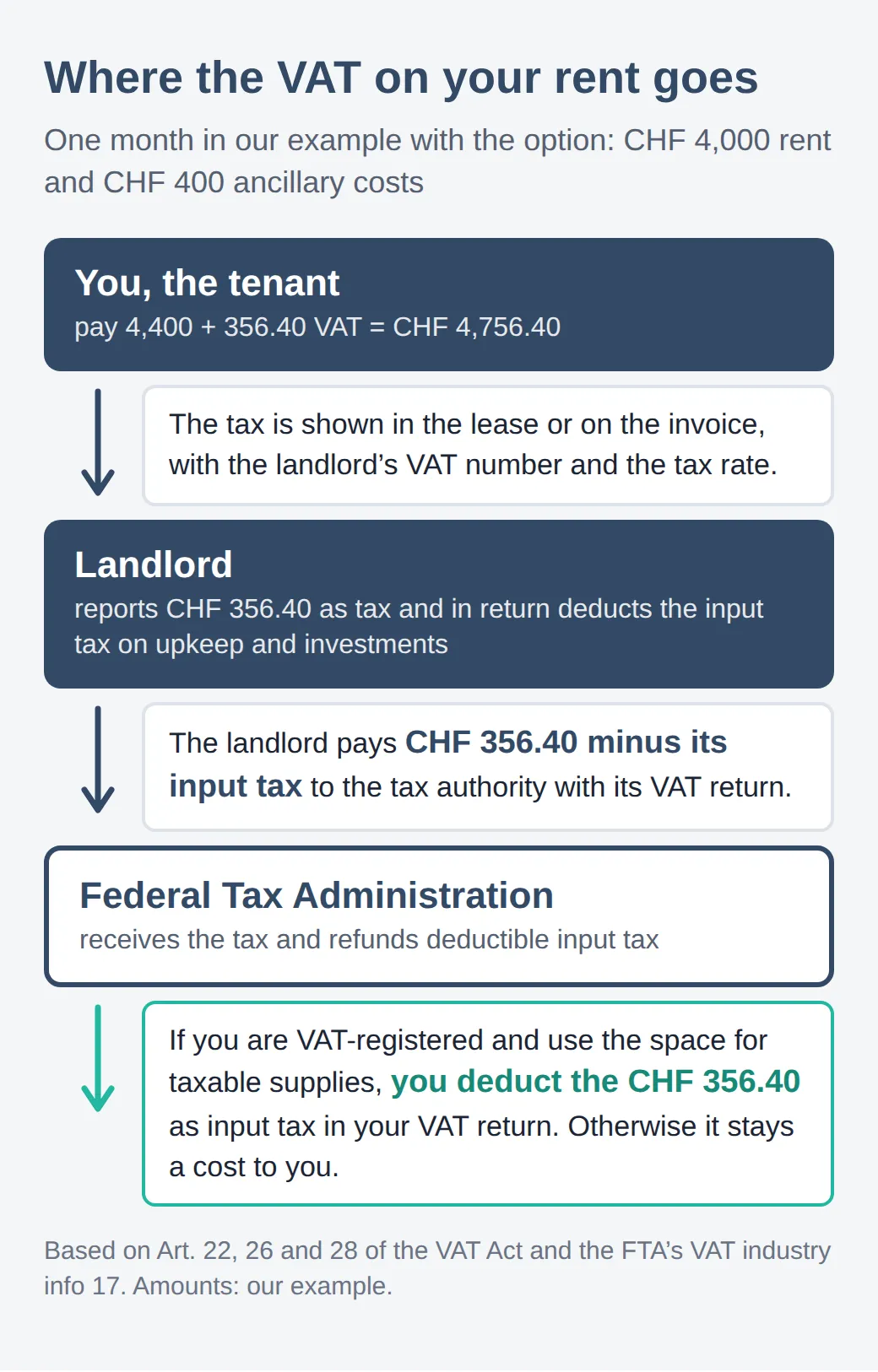
So whether the CHF 356.40 ends up as your cost does not depend on the landlord. It depends on your own VAT position.
Who gets the VAT back, and who pays it?
You can only get the VAT back if you are VAT-registered, use the effective reporting method and use the space for taxable supplies (Art. 28 VAT Act). An architecture office, an online shop or a workshop deducts the VAT on its rent as input tax in its next return. The option then only costs cash flow: you pay the VAT every month and usually get it back with the quarterly return (Art. 35 VAT Act).
For everyone else, the VAT is a cost like the rent itself. That covers four groups:
- Exempt activities: medical and physiotherapy practices, schools and course providers, insurers, banks and credit brokers make supplies that are exempt from VAT (Art. 21 para. 2 nos. 3, 11, 18 and 19 VAT Act). Space used for those supplies gives no right to deduct input tax (Art. 29 VAT Act).
- Mixed use: if you do both, say a practice that also sells care products, you cut the deduction in proportion to the use (Art. 30 VAT Act).
- Not VAT-registered: with less than CHF 100,000 a year in turnover from taxable supplies, you are exempt from VAT liability (Art. 10 VAT Act) and cannot deduct anything, unless you waive the exemption voluntarily.
- Net tax rate: businesses with up to CHF 5,024,000 of taxable turnover a year can report at a rate set for their sector, as long as their tax at that rate comes to no more than CHF 108,000 (Art. 37 VAT Act). That rate already allows for input tax as a flat amount, so input tax is not worked out item by item (VAT Info 12, section 1.2). The VAT on your rent does not come back to you separately.
The last group is the one many people miss. A hair salon reporting at a net tax rate is in the register and issues invoices with VAT, yet it still bears the VAT on its rent. Our example shows what that adds up to over the years:
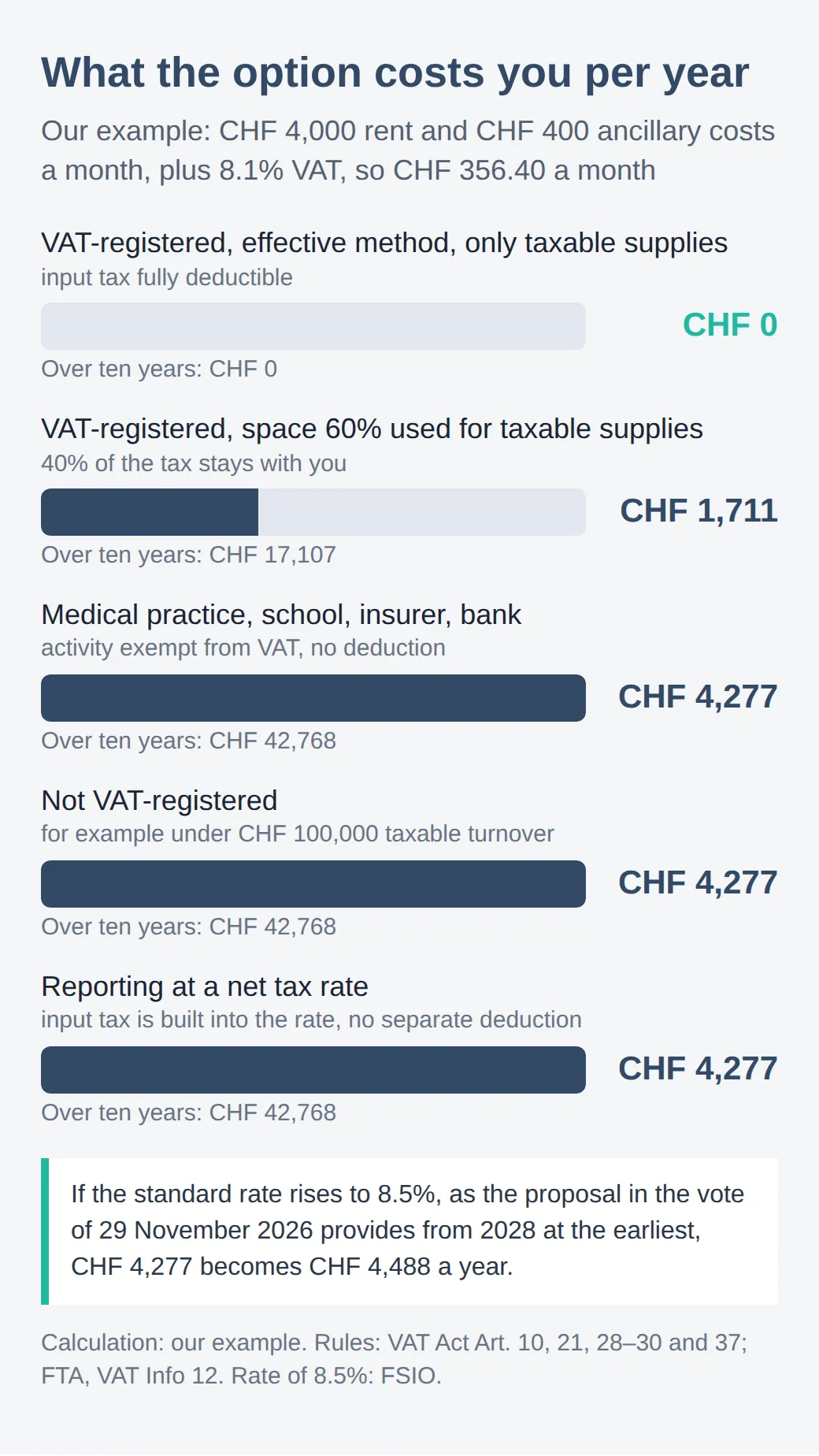
The sums are simple, and they need doing before you sign. Check with your accountant which group you fall into before you talk about price. After all, whether the option works for you also depends on what the landlord gets out of it.
Why landlords opt
A landlord opts because it lets them deduct input tax themselves. Without the option, the VAT on construction, conversion, upkeep and ancillary costs is a cost to them (Art. 29 VAT Act). With the option, they deduct that input tax: in full for painting work in your unit, and using an allocation key such as lettable floor area for the roof and facade (VAT industry information 17, section 6.4). On paper, a renovation costing two million francs plus VAT carries CHF 162,000 of input tax.
The catch for the landlord is a long commitment. If an opted tenant is followed by one without the option, the landlord has to repay part of the input tax deducted earlier (own use, Art. 31 VAT Act). In the reverse case, they can deduct it later (subsequent input tax deduction, Art. 32 VAT Act). For buildings, the amount to correct falls by only one twentieth a year, and the landlord has to keep the records for 26 years (section 3.2). A change of tenant can still cost them money many years after the building went up.
That explains two things you will find in leases. Landlords want to keep opted tenants as long as possible, and some reserve the right in the lease to turn down a replacement tenant who is not VAT-registered. And the option gives them a real benefit, one they can share with you. That decides whether the option is a good deal for you.
Pros and cons for you as a tenant
If you can deduct input tax in full, the option is neutral and can even save you money. The landlord lowers their own costs by opting. The commercial tenants' association, the Verband der Geschäftsmieter, advised back in 2018 that tenants should ask for a share of that benefit, in other words a lower net rent. On top of that, with the option your heating and ancillary cost statements carry VAT too, and you deduct that as well. Without the option, the VAT hidden in the ancillary costs stays with you, unseen.
For everyone else the drawbacks outweigh the benefits, and some only show years later:
- The option works like an 8.1% increase in rent and ancillary costs.
- An opted lease is harder to hand over. For a successor who cannot deduct input tax it costs the VAT on top, which can make it harder to transfer the lease together with your fit-out and fixtures.
- A clause letting the landlord turn down replacement tenants who are not VAT-registered narrows your way out. The commercial tenants' association advises striking it.
- Subletting gets more complicated, because you have to opt for the sublet yourself for the numbers to work.
What else a commercial lease should cover is in our article on the commercial lease contract. With an opted lease, it pays to think about your exit when you sign. It gets trickier still if the VAT only arrives during the tenancy.
Can the landlord opt in the middle of a lease?
For tax purposes they can at any time; under tenancy law, not just like that. If a landlord wants to change the lease unilaterally to your disadvantage, the same rules apply as for a rent increase (Art. 269d para. 3 CO). They have to notify you of the change on a form approved by the canton and give reasons, at least ten days before the notice period begins, and at the earliest for the next possible termination date. Without the form or without reasons, the increase is void. A letter saying "from next month, plus 8.1% VAT" is not enough.
If you receive such a form, you can challenge the change as unfair before the conciliation authority within 30 days (Art. 270b CO). We have not found a court ruling on exactly this case. The commercial tenants' association stated that tenants can successfully fight off the pass-through if the lease makes no provision for the option. Where the lease does have a pass-through clause, the association still says the official form is needed, with the tax rate or the tax amount stated separately. If you cannot deduct the VAT, also check whether the option lowers the landlord's costs while your net rent stays the same. That, in the association's view, is exactly where a challenge can start.
It is different when only the rate changes. When the standard rate went up from 7.7% to 8.1% at the start of 2024, the law firm Grell took the view that no form was needed, because the rate applies by law and the landlord is not the one changing it. Opting later in the lease, on the other hand, needs the form in their view. There is no ruling on this either. The safest route is a lease that settles the question from the start.
What the lease clause should say
The FTA recommends drafting opted leases so that the lease itself counts as an invoice. You can then deduct the input tax on the monthly payments directly on the strength of the lease, without the landlord sending an invoice every month.
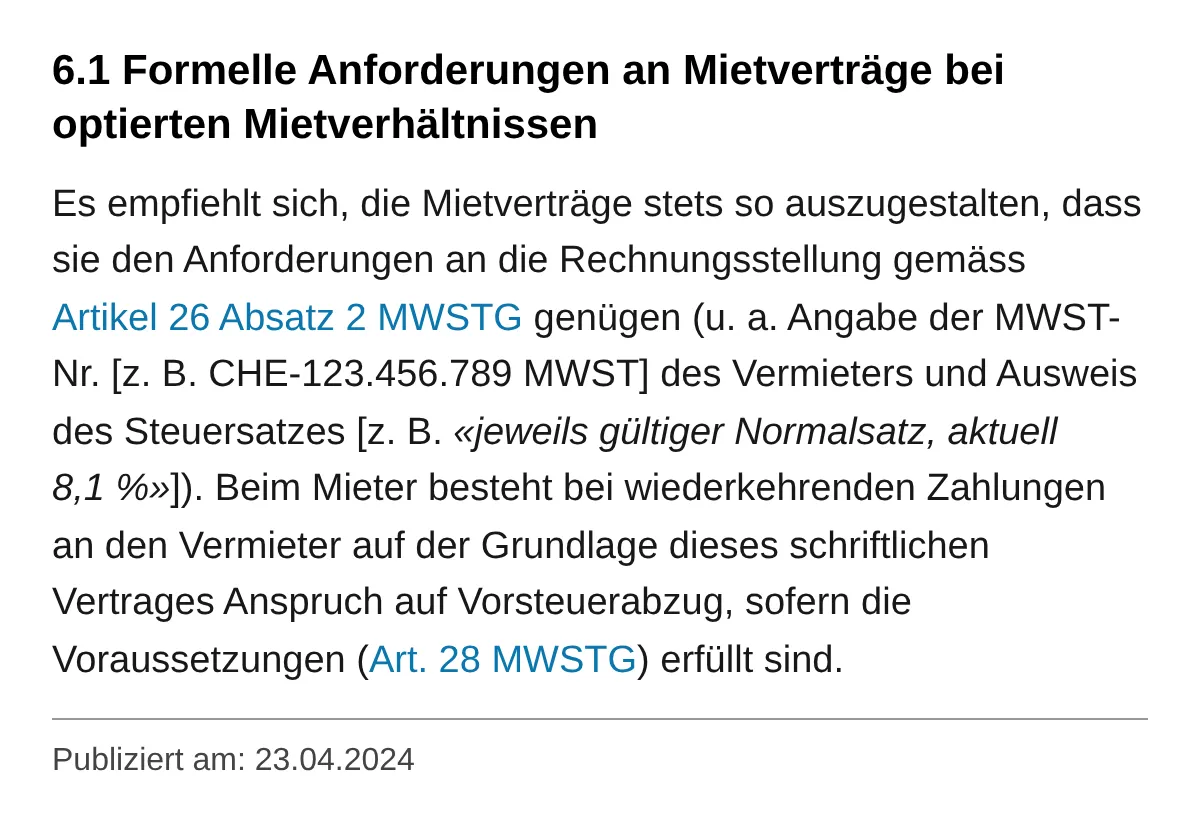
In concrete terms, Art. 26 VAT Act requires, among other things, the name and location of both parties, the landlord's VAT number, the nature of the supply, the consideration and the tax rate. The FTA's wording "the standard rate in force from time to time, currently 8.1%" («jeweils gültiger Normalsatz, aktuell 8,1 %») has one advantage: if the rate changes, nobody has to amend the lease. A clause that covers this and protects the tenant could read:
The landlord (VAT no. CHE-…) opts to tax this lease. VAT at the standard rate in force from time to time, currently 8.1%, is payable in addition on the net rent and the ancillary costs. The net rent of CHF … takes the landlord's input tax deduction into account. If the option ends, the net rent stays the same. A replacement tenant or subtenant may not be refused on the grounds that they are not VAT-registered. The ancillary cost statement shows VAT separately.
Before you sign, check the number in the UID register of the Federal Statistical Office, which shows the status in the VAT register. Anyone not registered may not show VAT on invoices, and anyone who shows VAT without being entitled to generally owes it anyway (Art. 27 VAT Act). In that case, ask for a corrected lease. Watch out, too, for clauses that pass the landlord's tax consequences on to you, such as their input tax correction when you move out or change how you use the space. That is their risk, not yours. The clause alone does not settle everything, though, because the VAT reaches further than the rent.
Ancillary costs, parking and fit-out
For the FTA, rent and ancillary costs are one unit. If the rent is opted, so are the ancillary costs, all at the standard rate, even where an item such as water would be taxed at a lower rate on its own (section 3.1). If the rent is not opted, the ancillary cost statements carry no VAT either. Electricity or water that a third party bills to you directly is different: that is a separate taxable supply, and as a VAT-registered business you deduct its VAT.
The law treats a separately rented parking space differently from the premises. Letting it is taxable as a rule, with no option needed (Art. 21 para. 2 no. 21 let. c VAT Act). It stays exempt only as an ancillary supply to a lease that is not opted, and only if several conditions are met together, including: the same parties to the contract, the space is yours for the whole term of the lease, it is in the same building complex or right next to it, and it is minor compared with the rent (section 7.4.2.2). If you rent the space from someone other than your landlord, say in a car park run by someone else, it is taxable even when your rent carries no VAT. If that landlord is VAT-registered, 8.1% is added.
For fit-out, one rule surprises many: if you rent a shell and fit it out at your own expense, as a VAT-registered business you deduct the input tax on that fit-out to the extent you use the space for taxable supplies, whether or not the landlord has opted (section 6.10.1). The FTA works this through with a fictitious company, Max AG, which puts CHF 200,000 plus CHF 16,200 of VAT into offices rented as a shell and deducts CHF 8,100 of it, because it is entitled to deduct for only half. If you later sell the fit-out to the next tenant, that is a taxable supply at the standard rate. If instead the landlord carries out the fit-out at your request and you pay a one-off sum for it, the landlord has to charge VAT at the standard rate, even if the rent itself is not opted (section 6.10.2). If the fit-out is built into the rent, it is treated the same way as the rent. What happens to your fit-out when the lease ends, though, is a question of tenancy law.
When money changes hands as you move out
A payment for ending a lease early is a taxable supply, even if the rent was never opted (section 6.12). If the landlord pays you to move out sooner, you owe VAT on that payment at the standard rate if you are VAT-registered. The same applies the other way round, when your successor pays you key money (Schlüsselgeld) for taking over your lease.
The FTA's example is a department store in a prime high-footfall location that receives CHF 500,000 from the landlord for ending the lease early. The amount counts as including VAT. At 8.1%, around CHF 37,465 of it goes to the tax authority. So if you are VAT-registered, always negotiate a payout with the words "plus VAT".
A rent reduction has a tax consequence as well. If the landlord lowers the rent after the fact, for instance because of a defect or building work, that counts on their side as a reduction of the consideration. If you deducted input tax on the full amount under an opted lease, you correct the deduction accordingly (section 6.11). So make sure your bookkeeping records every credit note from the landlord. That leaves the question of which rate to plan with for the coming years.
What a rate of 8.5% would change
On 29 November 2026, Swiss voters decide on a VAT increase to fund the 13th AHV (OASI) pension payment. According to the Federal Social Insurance Office (page in German), the standard rate would rise from 8.1% to 8.5%, from the start of 2028 at the earliest. In our example, the VAT would go up from CHF 356.40 to CHF 374 a month. If you cannot deduct it, you would pay CHF 4,488 instead of CHF 4,276.80 a year, so CHF 211.20 more.
If your lease says "the standard rate in force from time to time", the new rate applies automatically. If it says "8.1%" as a fixed figure, have that replaced with the wording above before you sign, so nobody has to argue about the rate later. For a lease you sign now for ten years, the rate is one of the smaller variables anyway. What matters far more is whether the landlord opts at all.
Before you sign
At every viewing, ask whether the rent is offered with or without VAT, and get the answer in writing. If the listing says "plus VAT" (zzgl. MWST), the option is already in place. What is left to negotiate is the net rent, the replacement tenant clause and the ancillary costs. If you compare offers, for example with our overview of office rents in Zurich, always count the VAT in. For a shop on turnover-based rent, the lease should also say whether turnover counts with or without VAT; how turnover rents work in general is in our article on renting a shop.
You will find office space where these questions come up in Bern, for example:
For a workshop, studio or commercial space, Lucerne is worth a look:
And if you are planning a physiotherapy or medical practice, build the VAT into every offer, whether in Zug or elsewhere. For you, a space with the option costs 8.1% more at the same net rent. That is an argument you can take into every negotiation.
Common questions
Can a landlord charge VAT on a live-work space?
Yes, as long as you do not use the space exclusively as a home. The Federal Tax Administration looks at each lease as a whole: if you live in one part and work in the other, the landlord can opt. You cannot deduct input tax on the part you live in, though.
Can I insist that my landlord does not charge VAT on the rent?
You have no legal right to it. The landlord decides for each lease whether to rent with or without VAT. You can still negotiate, and the time to do it is before you sign. If you cannot deduct input tax, you have good reasons to ask.
What if my landlord charges VAT but is not VAT-registered?
Anyone not entered in the Register of Taxable Persons may not show VAT on invoices. Check the landlord's status in the UID register of the Federal Statistical Office. If there is no entry, ask for a corrected lease or invoice without VAT before you pay any more.
Can I charge VAT when I sublet commercial space?
Yes, if you are VAT-registered yourself. Every tenant and subtenant can then opt for their own sublet, whatever the owner does. If your own lease is opted and you sublet part of it without VAT, you have to correct your input tax deduction for that part.
More from the blog
All posts
Renting practice space in Switzerland: permits and lease
What practice space for doctors, therapists and counsellors needs in Switzerland: licences, zoning, step-free access, soundproofing, X-ray and the lease.

Office rent per m² in Switzerland 2026: ten cities compared
What an office costs per m² a year: Geneva CHF 495, Bern 240, Biel 180. Asking rents, vacancy and 150 m² a month in ten Swiss cities.

Reference interest rate 2026: cutting your commercial rent
The 1.25% reference rate also covers commercial premises, but not index-linked, stepped or turnover rents. When to ask for a cut and which deadline counts.