Renting practice space in Switzerland: permits and lease
Before you sign
Practice space has to do more than an office. The municipality must allow it to be used as a practice, patients need step-free access, nobody in the waiting room should hear what is said next door, and an X-ray unit needs a federal licence that is tied to that exact room. Your personal licence to practise, on the other hand, covers the whole canton, not one address.
That sounds like paperwork, but it decides whether you're allowed to treat patients in the rooms you rent at all. And these are exactly the points a listing almost never mentions. In October 2026, we went through 2,090 office and commercial listings from 28 cities on our site. Of these, 132 name a practice or therapy as a possible use. What they reveal, and what they leave out, is the starting point of this guide for doctors, physiotherapists, psychotherapists and other health professionals renting their own premises for the first time.
What practice listings leave out
Listings describe what is easy to describe: location, floor area, light, parking. A lift is mentioned in 61 percent of practice listings. Only 27 percent say the space is wheelchair-accessible, barrier-free or step-free. That isn't a contradiction, because a lift alone doesn't make a building accessible if there are three steps in front of the entrance or the cabin is too small for a wheelchair.
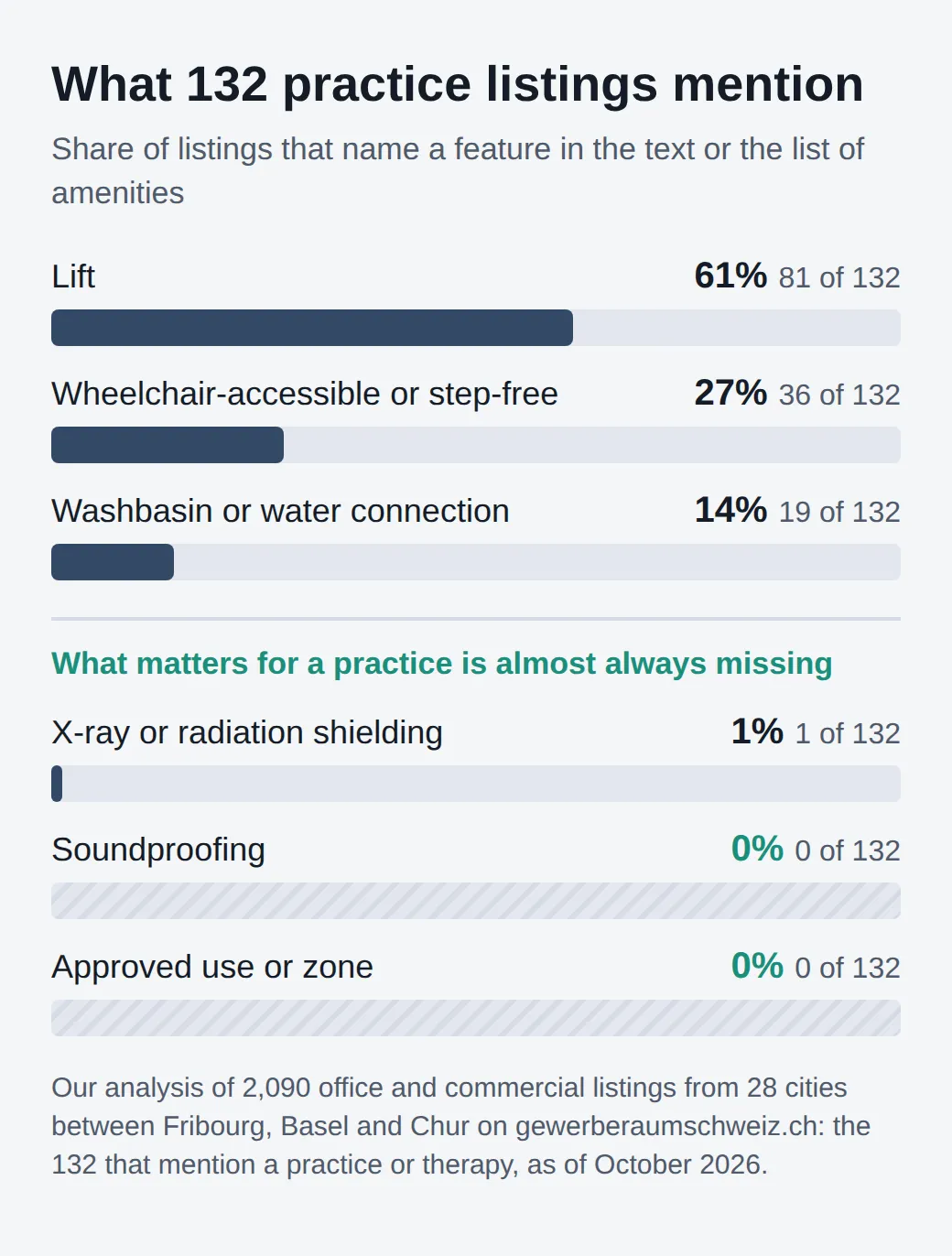
The gap widens the closer you get to the actual work of a practice. Nineteen listings mention a washbasin or a water connection, and sometimes that only means the basin in the toilet. X-ray comes up exactly once, as a possible installation in a space offered in shell condition in St. Gallen. Not a single listing mentions soundproofing, and none says whether the rooms are approved for use as a practice. You have to ask these questions yourself, and in a particular order: the licences first, then the rooms, then the lease.
Which licence do you need to open your own practice?
To run your own practice, you need a licence to practise from the canton where you work. That's set out for doctors, dentists and chiropractors in Art. 34 of the Medical Professions Act (in German), for psychotherapists in Art. 22 of the Psychology Professions Act (in German), and for physiotherapists, occupational therapists, dietitians, midwives and other health professions in Art. 11 of the Health Professions Act (in German). What counts is whether you work under your own professional responsibility: if nobody supervises you professionally, you need the licence, even as an employee of a limited company.
The licence is tied to you as a person. The canton checks your diploma, trustworthiness, health and language skills, not the rooms. The Zurich Health Directorate (in German) accepts applications no earlier than three months before you start, usually handles a complete application within six weeks, and doesn't allow you to start before the licence is granted. If you're self-employed, you must show professional liability insurance with cover of at least CHF 5 million.
You still can't do without an address entirely. In Zurich, doctors must report when they start practising and every time they move, as well as every additional location (§ 12 of the cantonal ordinance on the medical professions, cited in the guidance note for medicine, in German). The same applies to physiotherapists under the guidance note for physiotherapy (in German). If you move to another canton, you need its licence. If you already hold one, you generally meet the requirements there too (Art. 36 para. 4 of the Medical Professions Act, in German), and Zurich checks this in a simplified procedure that costs nothing. Still, allow a few weeks for it.
Admission to basic health insurance is a separate hurdle
If you want to bill compulsory basic health insurance, you also need admission as a service provider, again from the canton. Since 2021, doctors have faced an extra rule: cantons cap the number of doctors working in outpatient care at the expense of basic insurance in one or more specialties or in certain regions (Art. 55a of the Health Insurance Act, in German). Once the cap is reached, there are no new admissions. Zurich states on its page on admission (in German) that it is drafting the ordinance for this.
For your lease, that means: don't sign a ten-year contract before you know whether you'll be admitted in this canton and in your specialty. Without admission, basic insurance won't pay your bills. But what applies to you as a person doesn't automatically apply to a company.
When the licence depends on the premises
As soon as your limited company (GmbH) or company limited by shares (AG) runs the practice rather than you personally, the rooms come into play. In Zurich, every legal entity that provides outpatient medical services in its own name needs an operating licence as an outpatient medical institution. The Health Directorate's guidance note (in German) gets very specific: under the Disability Discrimination Act, the rooms, including access to the building and to the practice, must be suitable for people with disabilities, that is, wheelchair-accessible. The application must include floor plans with each room's function labelled and an explanation of how emergency services can reach the building.
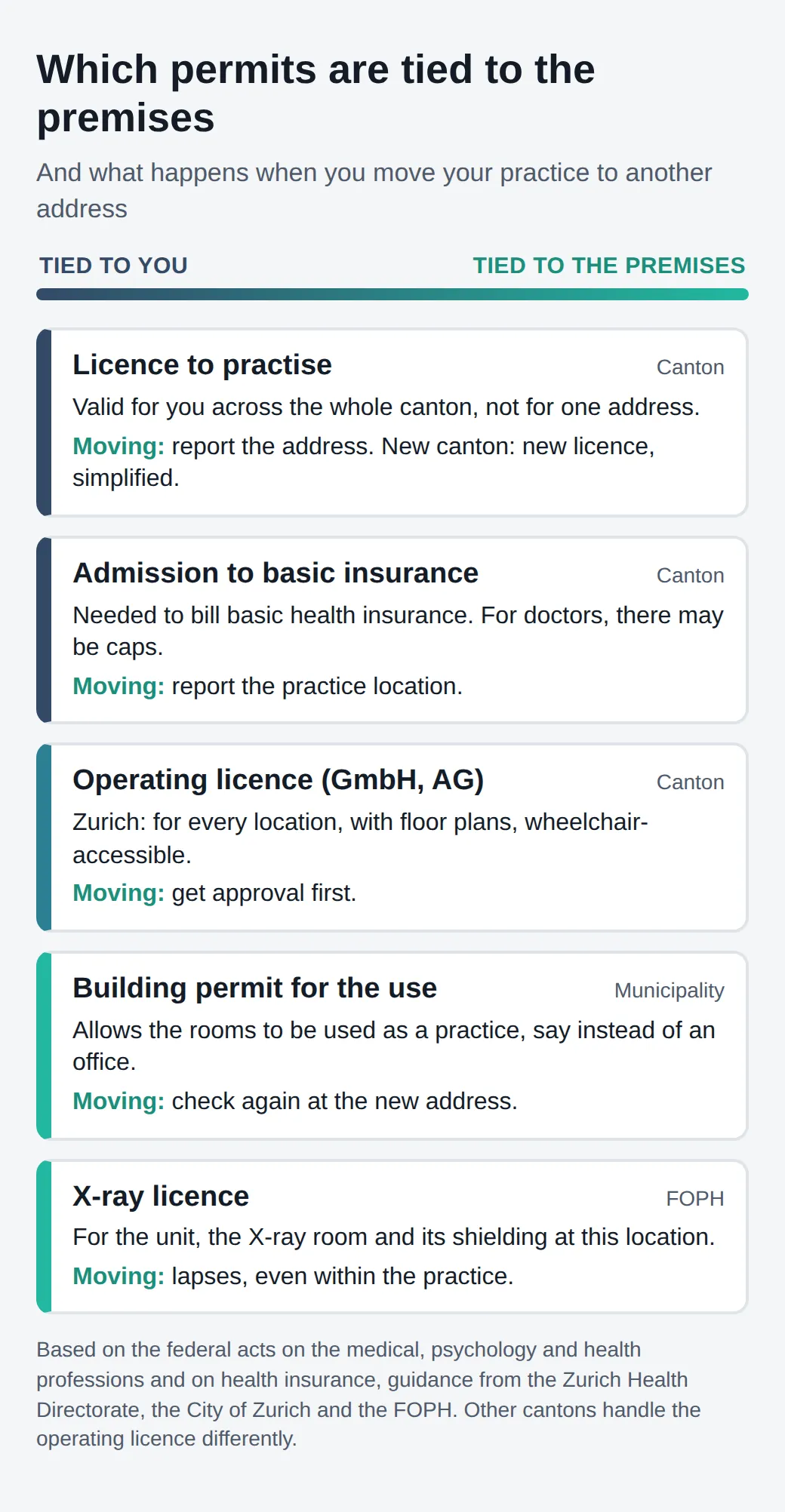
Every location must be covered by this licence. If you open, move or close a location, you must report it in writing beforehand for approval. According to the application page (in German), processing takes six to eight weeks, a retroactive licence is generally not granted, and anyone who deliberately runs an institution without a licence risks a fine of up to CHF 50,000. So a lease starting on the 1st of the month and an opening on the 2nd don't go together.
Other professions are treated differently. The Zurich Health Act doesn't provide for an operating licence for physiotherapy organisations. If such a company wants to bill basic insurance, though, it must define the geographical area it serves and have the necessary facilities (Art. 52 of the Health Insurance Ordinance, cited in the guidance note for physiotherapy). For psychotherapists, the number of rooms matters: anyone working under supervision must do so in the practice rooms of the licensed person, who usually has to be present, according to Zurich's guidance note for psychotherapy (in German). So if you want to employ psychotherapists in training, you need rooms for them in the same place.
Cantons handle this differently. Ask your canton's health department whether your legal form needs an operating licence and what it requires of the premises. Then ask the municipality whether the rooms may be a practice at all.
Can a medical practice be in a residential zone?
Often yes, but only within limits and frequently only with a permit. Whether a use is allowed depends on the zone the municipality has set for the plot. The City of Zurich sums it up in its answers on the building permit procedure (in German): residential zones are mainly for housing, businesses that cause little disturbance are allowed, and workspace may make up no more than a third of the residential floor area. Where a minimum residential share applies as well, a set part of the floor area must remain flats, calculated separately for each plot; the city's cadastre information shows how high that share is. So a practice in a third-floor flat can fail over a rule that has nothing to do with your practice.
More important still: even without any building work, switching to a practice can need a building permit. The City of Zurich expressly lists "a medical practice instead of an office" as an example of a change of use that needs a permit. A lot changes for the neighbours: patients come and go, taxis stop, opening hours differ from an office's. In Zurich, a regular application is put on public display for 20 days, and the neighbours can object. There's more on zones and changes of use in our post on storage and workshop space.
So ask the landlord in writing which use the rooms are approved for. If the answer is "office", expect to file a building application, and settle before you sign who submits it and who pays. Once a building application is under way, the question of access comes up too.
Step-free all the way to the treatment room
The Disability Discrimination Act doesn't require existing premises to be converted for no reason. For publicly accessible buildings, it applies when a permit to build them or to renovate their publicly accessible areas has been granted since 2004. For a practice, that has two consequences. If you convert and need a permit to do so, expect conditions on access. There is a limit: if the adaptation costs more than 5 percent of the building's insurance value or more than 20 percent of the renovation costs, the authority or court won't order it (Art. 12 DDA). And if you open a practice as a limited company in Zurich, you need wheelchair access for the operating licence anyway.
The benchmark for new buildings and conversions is the SIA 500 standard on barrier-free buildings. Your architect or the cantonal advice centre for barrier-free building will know it. For a viewing, a simpler benchmark will do. The disability organisation Procap has set out six minimum requirements (in German) for existing flats, and they also work as a first test for a practice:
- step-free access from the street to the entrance door
- a lift cabin 1.10 m wide and 1.40 m deep, with an 80 cm door
- no steps inside the rooms, and several floors connected by a lift
- corridors at least 1.20 m wide
- doors at least 80 cm wide and without a threshold
- a toilet with a shower of at least 1.65 by 1.80 m, or with a bath of 1.70 by 2.20 m
Take a tape measure with you. A lift in the listing isn't necessarily a lift for a wheelchair: Procap only accepts a cabin of 1.0 by 1.25 m as an exception in old buildings. For physiotherapy, this is the most important point of the whole viewing. For psychotherapy and counselling, something else matters more.
Soundproofing and professional confidentiality
What patients say in your practice is protected by criminal law. Doctors, dentists, psychologists, physiotherapists, occupational therapists, midwives and their assistants who disclose confidential information entrusted to them are liable, on complaint, to a custodial sentence of up to three years or a monetary penalty (Art. 321 of the Swiss Criminal Code). Assistants include, for example, the medical practice assistant at the reception desk. On top of that, the Data Protection Act requires technical and organisational measures appropriate to the risk (Art. 8 FADP).
The offence is disclosure, not a thin wall. But a wall through which you can understand every word from the therapy room while sitting in the waiting room makes your duty of confidentiality hard to keep in everyday practice, and patients soon notice. In converted offices, look out for lightweight partition walls that don't reach the concrete ceiling, doors without seals, shared ventilation ducts and a reception desk where the next patient can listen in.
Do a simple test at the viewing: one person speaks at a normal volume in the future treatment room while the other listens in the corridor and in the room next door. Ask what the partition walls are made of and whether you may fit soundproof doors or an acoustic wall lining. Such changes need the landlord's written consent (Art. 260a CO). Some of the listings on our site only offer a single room in an existing practice. There, also clarify who sees appointments and names at the shared reception. If you work with radiation, the walls face even stricter demands.
X-ray: a licence that lapses when you move
You may only install and operate an X-ray unit once the Federal Office of Public Health (FOPH) has licensed it. Under the Radiological Protection Ordinance, the FOPH is the licensing authority (Art. 11 RPO), and a licence is valid for ten years at most. The application must include radiation protection construction plans of the X-ray room and shielding calculations. The supplier of the unit usually helps with these.
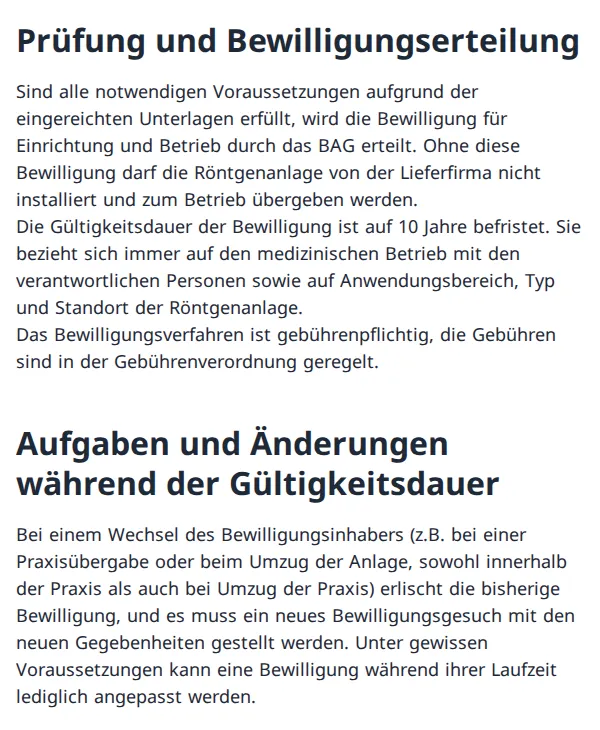
For renting, the last paragraph is what matters. The FOPH page (in German) states that the licence lapses when the unit is moved, "both within the practice and when the practice moves". Without a new licence, the supplier may not install the unit. So if you take over or set up a dental or medical practice with X-ray, plan the application before the lease starts, not after.
In the lease, shielding counts as a conversion. If the calculation calls for structural radiation protection in walls or doors, at the end it either stays in the building or is removed at your expense. Agree beforehand which applies. Heavy equipment also loads the floor. Ask about the permitted floor load before you order a unit.
What belongs in the lease for a practice
A commercial lease sets out the term, rent, deposit and ancillary costs, and the rules from our post on the commercial lease apply to these. A practice needs a few clauses of its own on top.
The purpose. The landlord must hand over the premises in a condition fit for the intended use and keep them that way, and for commercial premises the lease can't change that to your disadvantage (Art. 256 CO). What the intended use is follows from the lease. So don't write "office" or "services", but "general practice with laboratory" or "physiotherapy practice with training room".
The condition. Make the lease conditional on your obtaining the necessary permits. A sentence like this one is enough as a starting point for negotiation:
This lease is subject to the condition that the building permit for use as a medical practice, as well as the tenant's licence to practise and admission to compulsory health insurance, have been granted with final legal effect by 31 March 2027. The landlord shall sign the building application. If the condition is not met, the lease lapses without costs to either party.
The fit-out. Washbasins in every treatment room, extra sockets, soundproofing and shielding are changes your landlord must approve in writing. Once the landlord has agreed, they can only require you to remove them if that has been agreed in writing (Art. 260a CO). Keep a list of what you install, who pays and what may stay at the end.
The sign. A practice depends on people finding it. Agree on the right to put up a sign at the building entrance, in the lift and on the door. As for content, the federal advertising rules apply to medical professionals: advertising must be objective and may be neither misleading nor intrusive (Art. 40 of the Medical Professions Act, in German). In Zurich, the sign of an outpatient institution must also name the organisation running it and the persons responsible.
Sharing and handing on. If you let individual rooms to colleagues by the day, you need the landlord's consent for this sublease, which they may only refuse on the grounds set out in law (Art. 262 CO). And if you want to sell the practice one day, you can transfer the lease to your successor with the landlord's written consent, which they may only withhold for good cause (Art. 263 CO). You then remain jointly liable until the lease ends or could be terminated, but for two years at most.
Competition in the building. Tenancy law doesn't expressly say whether the landlord may let the floor above to a second practice in your specialty. If you want to rule that out, write an exclusivity clause into the lease.
VAT. Medical treatment by doctors, psychotherapists, physiotherapists and other health professionals with a licence to practise is exempt from VAT (Art. 21 VAT Act). So you can't reclaim the tax on the rent for this work as input tax. If the landlord opts for VAT, you bear the full tax. What that means in francs is explained in our post on the VAT option.
Go about it in this order
Before you talk about colours and furniture, settle four things, ideally in writing. First, with the cantonal health department: does your legal form need an operating licence, and is there a cap in your specialty? Second, with the landlord: which use are the rooms approved for? Third, at the viewing: a tape measure for doors, corridor and lift, a conversation through the wall, a look at the reception. Fourth, in the lease: purpose, condition, fit-out and sign. If you use X-ray, file the application with the FOPH in between.
If you want to start looking: practice space appears on our site both under offices and under commercial space. For Zurich, it's worth checking both lists, the commercial spaces and the offices:
In Bern, in October 2026, several listings in the Old Town and near the station expressly offered space as an office or a practice:
In Basel at the same time, a building on Aeschenvorstadt offered office and practice space, "partly" with washbasins. It is handed over in shell condition if you don't take over the existing fit-out with its lightweight walls. Then you plan the rooms yourself, and every question in this post is yours from the start.
Common questions
Do I need my own licence if I only rent a room in a shared practice?
Yes. If you treat patients under your own professional responsibility, you need the canton's licence to practise, even if you only rent a room by the day. In Zurich, a medical institution with an operating licence must give the cantonal health office the names of the doctors who regularly use its rooms, along with the usage agreements. You also report the location in your own name.
Is my licence to practise still valid if I move my practice to another canton?
No, you need a licence from the new canton. If you already hold a cantonal licence, you generally meet the requirements there too, and Zurich uses a simplified procedure for this that costs nothing. You may work in another canton without its licence for up to 90 days per calendar year, but you have to register there.
Can I run a practice from my rented flat?
Only with your landlord's consent, because your lease allows you to live there, not to run a practice. Building law also applies: in the residential zones of the City of Zurich, workspace may make up no more than a third of the residential floor area, and a new use can need a building permit. Clear up both before you see your first patient.
What happens to patient records when I close my practice?
They remain your responsibility. The Zurich Health Directorate expects doctors to make sure patients can still ask for their records after the practice closes, for example through rented storage or a specialist archiving service. Tell the cantonal health office how and where this is arranged, no later than when you close.
Does the landlord have to install sinks and plumbing for a medical practice?
The law requires the landlord to hand over the premises in a condition fit for the agreed use. What that means for washbasins, three-phase power or shielding is a source of dispute unless the lease spells it out. So write into the lease which installations the landlord provides, which you build yourself and who removes what at the end.
More from the blog
All posts
Office rent per m² in Switzerland 2026: ten cities compared
What an office costs per m² a year: Geneva CHF 495, Bern 240, Biel 180. Asking rents, vacancy and 150 m² a month in ten Swiss cities.

VAT on commercial rent in Switzerland: who pays in 2026
If your landlord opts to charge VAT, 8.1% is added to rent and ancillary costs. Who reclaims it, who bears it, and what your lease clause should say.

Office rent in Zurich 2026: price per m² by area
A Zurich office costs a median CHF 250 per m² a year in Altstetten and CHF 625 in the City. Rents by area, service charges, fit-out and a worked example.