Office rent per m² in Switzerland 2026: ten cities compared
The ranking first
An office in the larger Swiss cities costs between CHF 180 and 495 per square metre a year. Geneva is the most expensive, with a median of CHF 495, followed by Lausanne at 300, Lugano at 270 and Basel at 255. Biel is the cheapest at 180. These are the asking rents for 2025 from the CSL Immobilien market report, and the offices on our site in October 2026 came out at almost the same figures.
Search for office rent per square metre and you mostly find one figure for the whole of Switzerland, or a table with no year and no source. Whether it means the city or the wider region, a listing or a signed lease, with or without ancillary costs, is rarely stated. Yet these details can easily make a difference of CHF 100 per square metre. We keep these things apart here, show how much space is free in each city and work out what 150 square metres cost a month.
The ranking: ten cities in one table
The figures in the second column come from the 2026 property market report (in German) by CSL Immobilien, a property services firm with offices in Zurich and Lausanne. Every year CSL analyses the advertised office space and gives the median for each region: half the offers are above it, the other half below. Geneva, Lausanne, Basel, Bern and St. Gallen have figures for the city itself; Lugano, Zug, Lucerne, Winterthur and Biel only for the agglomeration, meaning the city with its neighbouring municipalities. The third column is our own analysis of the offices listed on our city pages in October 2026.
| City | CSL, listings 2025 (CHF per m² a year) | Our listings, Oct. 2026 | 150 m² a month, per CSL |
|---|---|---|---|
| Geneva | 495 | 495 | 6,188 |
| Lausanne | 300 | 300 | 3,750 |
| Lugano (agglomeration) | 270 | 279 | 3,375 |
| Basel | 255 | 249 | 3,188 |
| Zug (agglomeration) | 250 | no figure | 3,125 |
| Bern | 240 | 232 | 3,000 |
| Lucerne (agglomeration) | 235 | 197 | 2,938 |
| Winterthur (agglomeration) | 220 | 200 | 2,750 |
| St. Gallen | 210 | 205 | 2,625 |
| Biel (agglomeration) | 180 | 180 | 2,250 |
And Zurich? The city would sit clearly in second place at CHF 385; on our site it was 350. How widely prices there vary between the centre and Altstetten is covered in our post on office rents in Zurich.
The cities for which CSL gives both figures show how much the boundary matters. In the city of Geneva the median is CHF 495, across the whole agglomeration 350. In Basel it's 255 against 195, in Bern 240 against 205, in Lausanne 300 against 255. So when you read a figure for "Geneva", first ask which Geneva is meant.
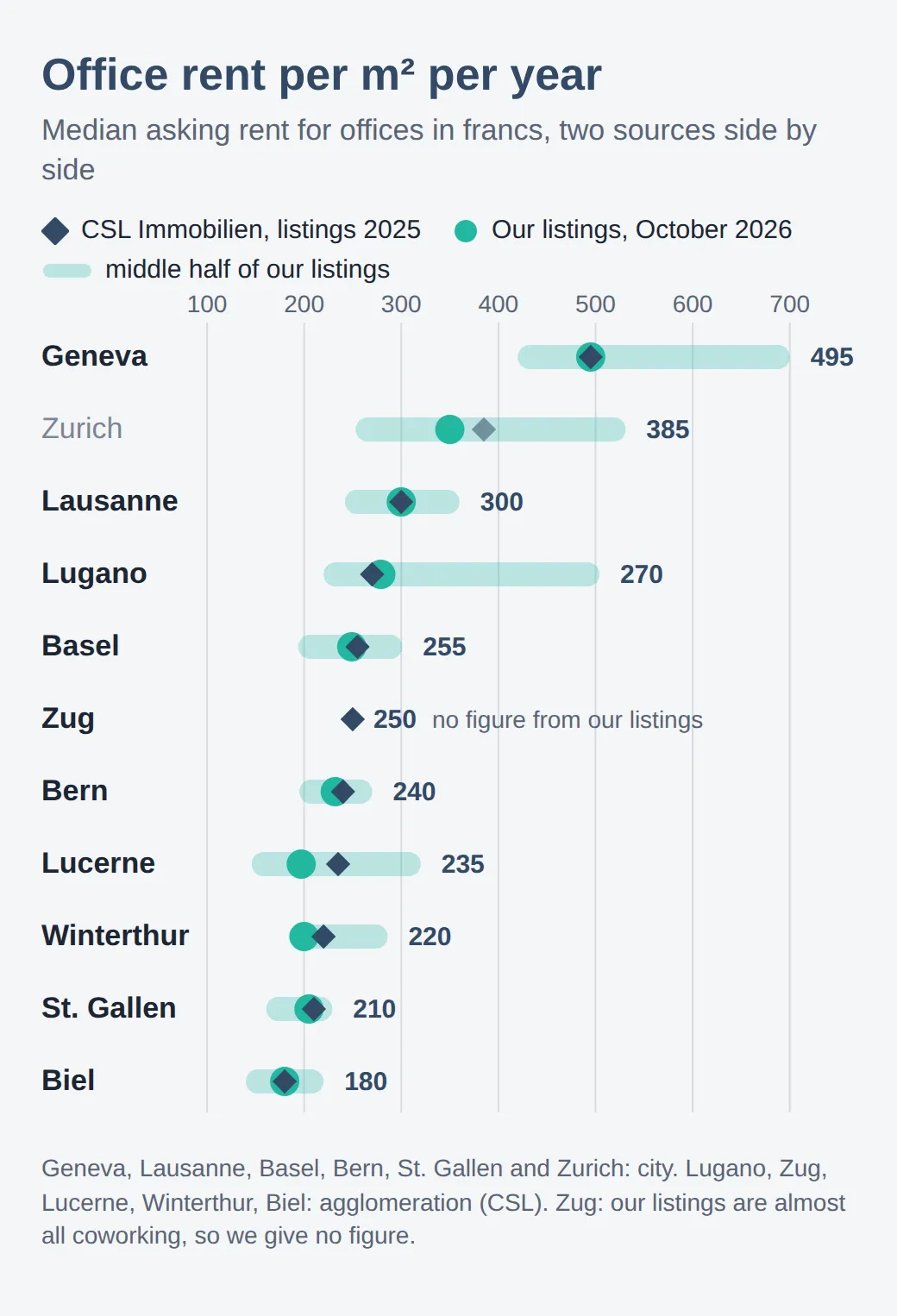
The two sources don't measure exactly the same thing, and they are a year apart. That makes it all the more striking how close they are: in Geneva, Lausanne and Biel the medians are identical, and in Lugano, Basel, Bern and St. Gallen they are less than ten francs apart. The gap is only wider in Lucerne and Winterthur, where our figures cover the city alone and, in Lucerne, rest on 24 listings. With so few offers, a single building can shift the median. We give no figure for Zug, for reasons explained further down.
Asking rent, contract rent, prime rent
All the figures in the table are asking rents: prices a landlord puts in a listing. What ends up in the lease, the contract rent, is not published for offices by any authority or by any of the market reports we read. How far apart the two are depends on how much space is empty in a location and how long a unit has been on the market. Where a lot is free, you have more room to negotiate on price, rent-free months or a contribution to the fit-out.
A third figure turns up in headlines: the prime rent. It applies to the best space at the best addresses. According to Wüest Partner (in German), it stood at CHF 1,100 per square metre a year in Geneva at the end of 2025 and most recently at 1,050 in Zurich. Bern and Basel, at 500 and 450, are at their highest in ten years. In Lausanne it has hovered around 470 to 480 since 2016. In Geneva, then, the prime rent is more than twice the city median. For an ordinary office it's no yardstick.
What counts for you is mainly the median in the area where you're looking. That holds legally too: whether a rent is unfairly high is measured, among other things, against the rents customary in the locality or district (art. 269a CO). For commercial premises, that comparison may expressly be made with the usual price per square metre of similar premises in the neighbourhood, and official statistics must be taken into account (art. 11 VMWG, the federal rent ordinance, in German). But before you compare two prices per square metre, you need to know what's in them.
Net or gross: what the median may leave out
A price per square metre without the words "net" or "including ancillary costs" is only half the information. Of the 1,380 offices with a price on our eleven city pages, only 408 show the ancillary costs separately. For the rest, it's unclear whether heating, caretaking and electricity for the common areas are already included. Almost half the listings we could analyse also give a rate per square metre a year rather than a monthly amount.
Where both net rent and ancillary costs are given, the ancillary costs have a median of CHF 31.50 per square metre a year, with the middle half between 25 and 41 francs. That's about 12 percent of the net rent. For our medians we took the net rent wherever the listing states it. CSL doesn't say on its page whether its figures are net or gross. So add a surcharge of that order to every comparison, unless the ancillary costs are expressly included.
Two more items are missing from every price per square metre. If the landlord has opted to charge VAT, it comes on top of rent and ancillary costs. What that means for your company is explained in our post on the VAT option. And parking spaces are usually let separately.
Geneva: the most expensive, yet plenty of vacant space
Geneva leads the ranking by a wide margin. In the city the median is CHF 495, and CSL's price range runs from 325 to 855. Across the region the differences are large: CHF 610 in the central business district (CBD), 550 on the Rive Gauche, only 260 in Meyrin and Vernier and 280 in Plan-les-Ouates. An office in Meyrin or Vernier therefore costs less than half as much as one in the CBD.
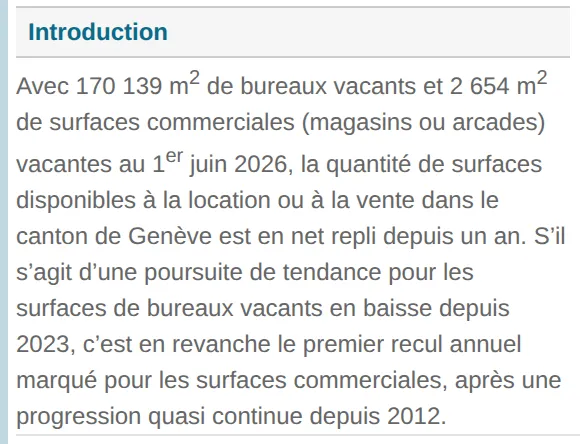
At the same time, a lot of space stands empty in Geneva. Every year on 1 June, the cantonal statistics office OCSTAT counts the empty offices in the canton offered for rent or for sale. In 2026 there were 170,139 square metres. That's well below the 314,075 square metres of 2023 and back to roughly the level of 2015 to 2022, when the figure lay between just under 158,000 and just over 234,000 square metres. That's what the OCSTAT time series since 1977 shows.
The consultancy JLL measures the availability rate, the share of available space in the total stock. For the Geneva region it was 6.1 percent in the second quarter of 2026. According to JLL, demand is mainly for the best buildings, while a lot has stood empty in outlying areas for years. CSL names Meyrin and Vernier, near the airport, where some spaces have long struggled to find tenants. For you, that means you pay the Geneva price in the centre, while on the outskirts you have choice and room to negotiate.
Lausanne and Lugano: the middle of the ranking
Lausanne, with a city median of CHF 300, is well behind Geneva. In the CBD it's CHF 350, in Lausanne West 245 and in Lausanne North 175. CSL describes a two-tier market: because of the many building sites in the city centre, larger firms tend to look on the outskirts, where rents are lower and the motorway is closer. Smaller spaces, on the other hand, are now hard to let unless they're already fitted out.
There's less free space in Lausanne than in Geneva, but more than a year ago. According to JLL, the availability rate in the city rose from 1.9 to 3.3 percent by the end of 2025, and to 5.2 percent in the region. In Lausanne West and Crissier it was 15 percent. If you're looking there, you're looking in a market with plenty of choice.
Lugano has an agglomeration median of CHF 270, with a very wide range of 170 to 515 francs. Relative to the median, only Zug's range is wider among the ten cities. On our site, too, asking prices in Lugano vary widely: the middle half runs from CHF 220 to 504. An average doesn't help much there; it comes down to the individual building. According to CSL, supply grew by only 6 percent, to just under 118,000 square metres.
Basel and Bern: same price, different market
Only CHF 15 separates the medians of Basel and Bern: 255 in the city of Basel, 240 in the city of Bern. But the markets behind them are heading in opposite directions.
In Basel, supply is shrinking. CSL counts 105,500 square metres of advertised office space in the city, half as much as the year before. Part of it has been let, for example the offices in the main post office building to Basel Tourism and the cantonal Presidential Department. Another part has simply left the market, because the canton converted a building in Kleinhüningen into flats. According to JLL, the region's availability rate fell to 4.7 percent in the second quarter of 2026, below 5 percent for the first time since the end of 2019. Basel-Stadt also publishes every year how much office space is empty: on 1 June 2025 it was 132,700 square metres (in German), and according to the latest survey office supply fell slightly again in 2026.
In Bern, by contrast, supply is growing. CSL counts 27 percent more advertised space in the city, and as much as 162 percent more in the Innere Stadt, the old town district. The reason: the railway company BLS has brought its offices together in its new building in Ausserholligen and left several thousand square metres behind in the old town, and the federal administration is also moving out of the centre. Even so, Bern remains tight: JLL puts the region's availability rate at 2.5 percent at the end of 2025, and only 1.0 percent in the city centre. Across the five largest office markets in Switzerland, it was 5.2 percent at the same time. Between 2026 and 2028, however, more than twice as much is due to be built each year as the average since 2016.
For tenants, the picture is turning around: in Basel your room for manoeuvre is shrinking, in Bern it's growing, if from a low level.
Zug: a median with a question mark
According to CSL, Zug has an agglomeration median of CHF 250, almost as much as the city of Basel, with a range of 160 to 495 francs. Supply there grew by 62 percent in 2025, to just over 187,000 square metres. CSL puts this down to newly announced projects already being advertised.
Our own figures are no use for Zug. Of the 67 office listings on our Zug page, 60 mention coworking; most are furnished offices priced per desk or per room, often with access to shared meeting rooms. Setting such prices per square metre next to an ordinary rent would be comparing apples with oranges. If you're looking for an office of your own in Zug, ask specifically about the new projects that CSL says are already being advertised, and negotiate fit-out and term early.
Lucerne, Winterthur, St. Gallen and Biel: under CHF 240
In these four cities the medians lie between CHF 180 and 235. The Lucerne agglomeration comes in at CHF 235, Winterthur at 220, the city of St. Gallen at 210 and Biel at 180. What they have in common is that supply grew strongly in 2025: by 64 percent in Lucerne, 63 in Biel, 44 in the city of St. Gallen and 28 percent in Winterthur.
In Biel and St. Gallen, the areas involved are smaller than the percentages suggest: just under 24,000 square metres are advertised in Biel, and just over 68,000 in the city of St. Gallen. For St. Gallen, CSL points out that in such a small market even a few large spaces move the rates sharply. In the Centrum, the largest submarket with a median of CHF 225, supply stayed almost unchanged at just over 32,500 square metres. The growth came in the districts to the east and west of the city.
Our site shows the same price level: CHF 205 in St. Gallen, 200 in Winterthur, 180 in Biel. Our figure for Biel rests on only 23 listings, though, and the one for Lucerne on 24. If you're looking in these cities, you have less choice than in Geneva or Basel, but it is growing.
Where you have more room to negotiate
How much space is free tells you more about your negotiating position than the price itself. There's no single official figure for it: the Federal Statistical Office counts only empty dwellings on 1 June, not offices. Geneva and Basel-Stadt survey empty offices themselves; for the other cities, you have to rely on market reports. The following table sets CSL's advertised office space next to the figures from JLL and the two cantons.
| City | Advertised 2025 (CSL) | Change on 2024 | Vacancy or availability rate |
|---|---|---|---|
| Geneva (city) | 201,164 m² | +21 % | Canton: 170,139 m² empty on 1 June 2026 |
| Lausanne (city) | 101,202 m² | +16 % | City 3.3 %, region 5.2 % (JLL, end 2025) |
| Lugano (agglomeration) | 117,857 m² | +6 % | no figure |
| Basel (city) | 105,500 m² | -51 % | Region 4.7 % (JLL, Q2 2026); canton: 132,700 m² empty on 1 June 2025 |
| Zug (agglomeration) | 187,255 m² | +62 % | no figure |
| Bern (city) | 125,034 m² | +27 % | Region 2.5 %, centre 1.0 % (JLL, end 2025) |
| Lucerne (agglomeration) | 127,154 m² | +64 % | no figure |
| Winterthur (agglomeration) | 78,088 m² | +28 % | no figure |
| St. Gallen (city) | 68,365 m² | +44 % | no figure |
| Biel (agglomeration) | 23,732 m² | +63 % | no figure |
Don't read the second column as vacancy: CSL counts what is advertised, in Zug for instance also projects that have only been announced. But it shows the direction. Where supply is growing strongly, as in Lucerne, Zug, Biel or St. Gallen, you're in a stronger position to ask for rent-free months, a contribution to the fit-out or a shorter term. In Bern's old town and Geneva's best locations, that room is smaller.
What 150 square metres cost a month
For the comparison we use the same area as in our Zurich post: 150 square metres. The sum is simple. Multiply the median by the area and divide by twelve. In Geneva that's 495 times 150 divided by 12, or CHF 6,187.50 a month. In Biel the same space costs CHF 2,250. If ancillary costs at our median come on top, that's roughly another CHF 394 a month, unless they're already in the price.
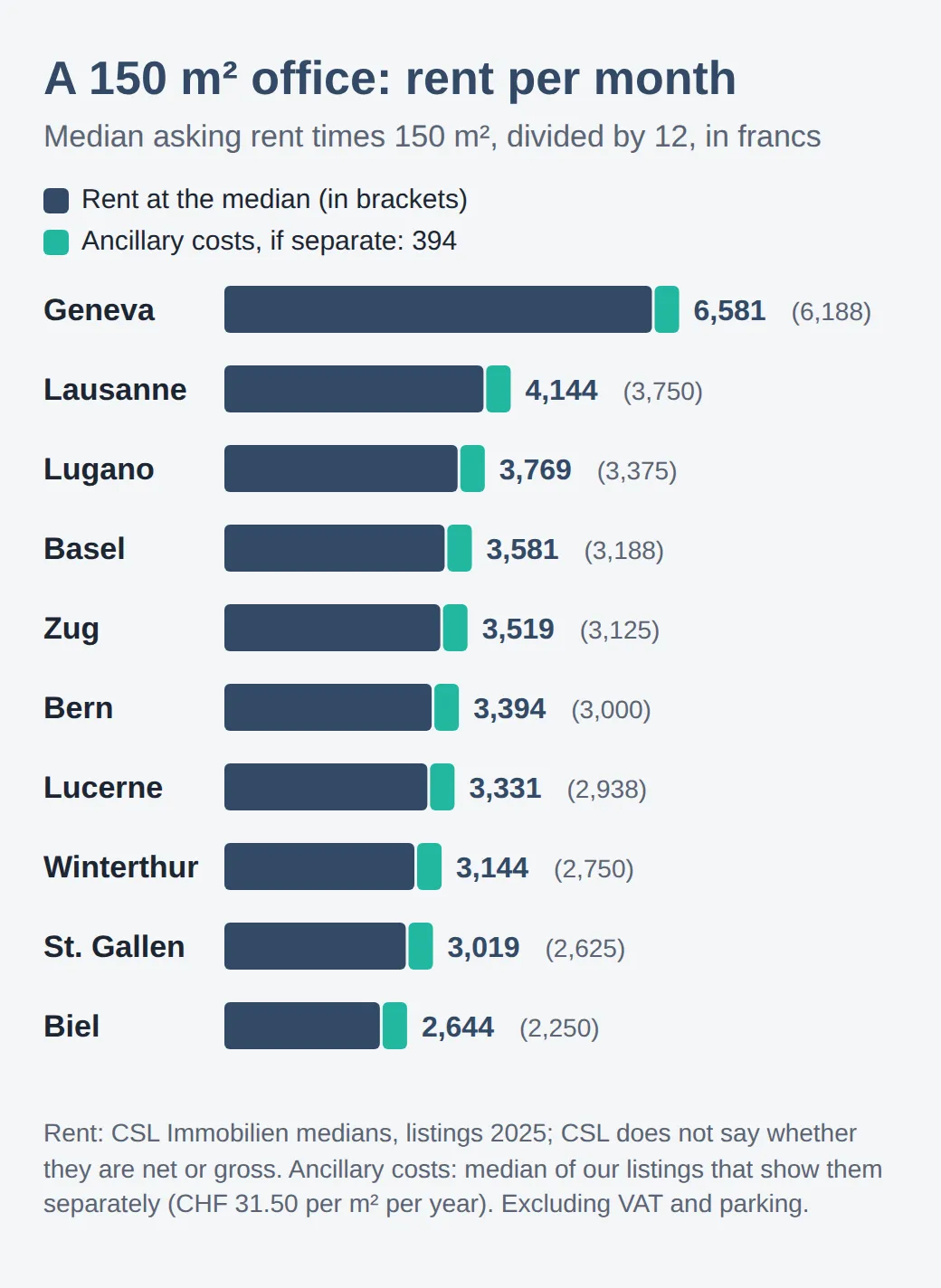
Between the most expensive and the cheapest city, that's CHF 47,250 of rent a year, and just over CHF 236,000 on a five-year lease. Between Basel and Bern, on the other hand, it's only about CHF 190 a month. So often it's not the city alone that decides, but the location within it: in Geneva the same space costs CHF 7,625 a month in the CBD at the median, and 3,250 in Meyrin and Vernier.
Parking, VAT if the landlord has opted for it, and the fit-out are not included. A shell-and-core space is cheaper per square metre, but then you pay for the fit-out. For every offer, work it out over the whole fixed term, not just the first month.
How to use the figures
Put every offer next to two figures: the city median and, where there is one, the median for the district. If a price is well above, ask what it offers on top, such as a finished fit-out, better transport links or parking. If it's below, check whether the ancillary costs are missing or whether the space is handed over as shell and core. And always ask for the ancillary cost statements of the past few years.
In cities with fast-growing supply, you have time and arguments on your side. There it pays to view several spaces and to negotiate not only the rent, but also the term, a renewal option and the fit-out. What to look out for in the lease itself is covered in our post on the commercial lease. CSL's figures come out once a year; our listings change every day. You'll find the current picture for your city on its own page.
Common questions
How do I convert a price per m² per year into a monthly rent?
Multiply the price by the floor area and divide by twelve. A 120 m² office at CHF 260 therefore costs 120 times 260 divided by 12, which is CHF 2,600 a month. Then check whether ancillary costs are already included.
Why do market reports give different office rents for the same city?
Usually they don't mean the same area. CSL Immobilien puts the median for the city of Geneva at CHF 495, but at 350 for the whole agglomeration. On top of that come different years, averages instead of medians, or prime rents instead of ordinary offers. So only compare figures from the same source and for the same area.
Are there official statistics on office rents in Switzerland?
No. The Federal Statistical Office counts only empty dwellings on 1 June, not offices. Geneva and Basel-Stadt publish how much office space is empty, but no rents. For prices, you have market reports and the listings themselves.
Can I challenge an excessive initial rent for an office in Switzerland?
Yes, within 30 days of taking over the premises, at the conciliation authority. You can do so if you had to sign because of hardship or the state of the local market, or if the rent is significantly higher than the previous tenant's. For commercial premises, the comparison can be made with the usual price per square metre of similar premises in the neighbourhood.
More from the blog
All posts
Renting practice space in Switzerland: permits and lease
What practice space for doctors, therapists and counsellors needs in Switzerland: licences, zoning, step-free access, soundproofing, X-ray and the lease.
VAT on commercial rent in Switzerland: who pays in 2026
If your landlord opts to charge VAT, 8.1% is added to rent and ancillary costs. Who reclaims it, who bears it, and what your lease clause should say.

Reference interest rate 2026: cutting your commercial rent
The 1.25% reference rate also covers commercial premises, but not index-linked, stepped or turnover rents. When to ask for a cut and which deadline counts.