Reference interest rate 2026: cutting your commercial rent

The short answer
The reference interest rate applies to commercial premises just as it does to flats, and it has stood at 1.25 percent since 2 September 2025. If your rent is still based on 1.5 percent or more, you can ask for a reduction. That only works for an ordinary rent, though, not for index-linked, stepped or turnover rents, and the lower rent only takes effect on the next termination date, with six months' notice.
For an office, a shop or a workshop, then, your lease matters more than the rate itself: what kind of rent it sets, what fixed term, which termination dates. We go through it step by step, with a worked example in francs, a sample letter and two Federal Supreme Court rulings you should know if your lease contains an index or a minimum rent.
Does the reference interest rate apply to commercial premises?
Yes. The protection against unfair rents in the Code of Obligations (CO; the English version is an unofficial translation) covers both residential and commercial premises. The only exceptions are luxury flats and single-family houses with six or more living rooms, and subsidised housing whose rent is controlled by an authority (Art. 253b CO). Commercial premises fall under none of these.
The reference interest rate itself is quickly explained. It is based on the average interest rate on all mortgages held by Swiss banks, rounded to the nearest quarter percent and published every quarter by the Federal Office for Housing (FOH; page in German, French and Italian), as set out in Art. 12a VMWG (the tenancy ordinance, in German, French and Italian only). If the rate rises by 0.25 percentage points, the rent may go up by 3 percent. If it falls by 0.25 points, you are in principle entitled to 2.91 percent less (Art. 13 VMWG). The 2.91 is not a typo: it exactly reverses a 3 percent increase.
Only the net rent is affected. Ancillary costs stay as they are. The average rate stood at 1.31 percent at the end of June 2026, and according to the FOH announcement of 1 September 2026 (in German, French and Italian), the reference rate stays at 1.25 percent until the average falls below 1.13 or rises above 1.37 percent. The next announcement is scheduled for 1 December 2026.
So much for the rule. Whether it reaches your lease at all depends on the kind of rent you pay.
Index-linked, stepped, turnover: where the rate does not apply
Many commercial leases follow an index, rise in fixed steps or depend on turnover. The reference rate does not apply to any of the three, and the FOH says so explicitly in its announcements:
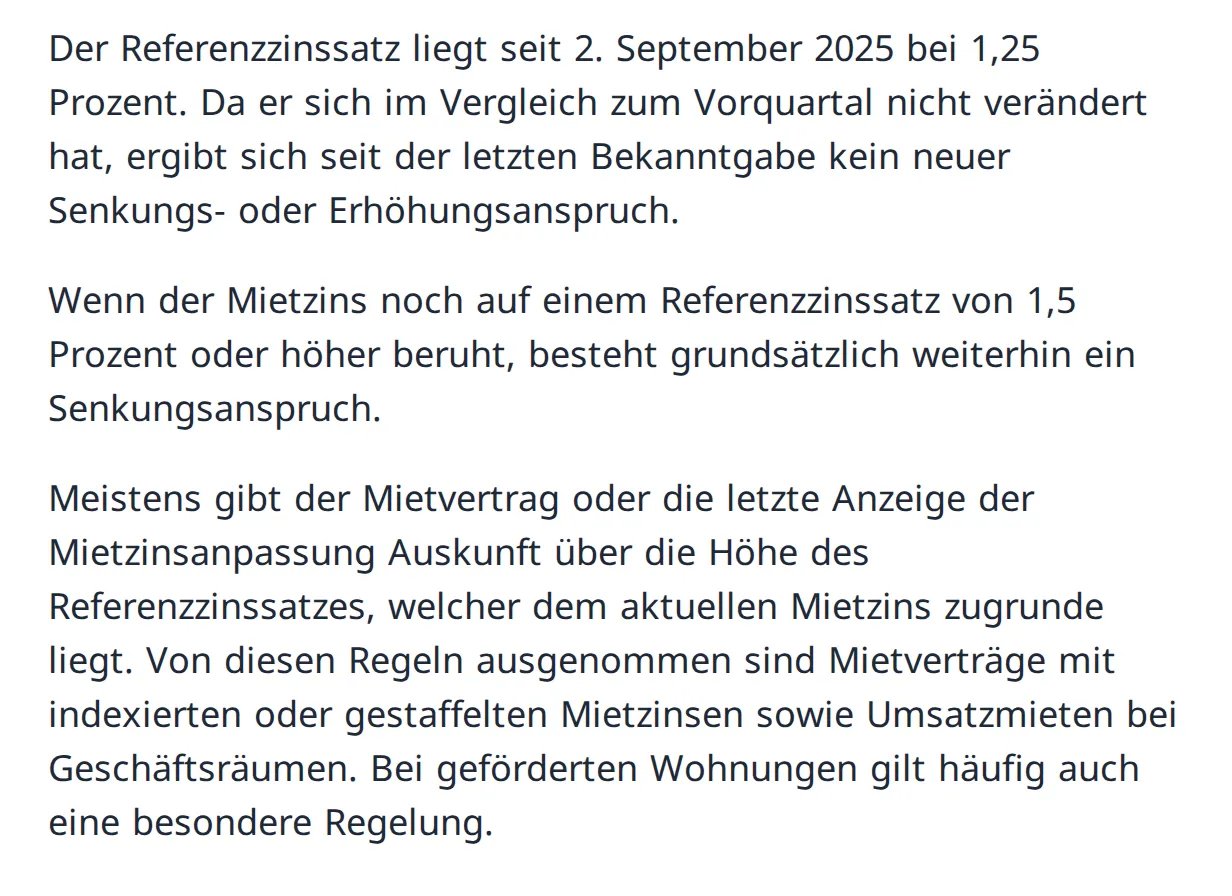
The four cases at a glance, with the point from which the reference rate counts again:
| Your lease | Reference rate counts? | When it counts again |
|---|---|---|
| Ordinary rent, open-ended | yes | any time, effective from the next termination date |
| Index-linked rent (at least 5 years fixed) | no | at the end of the index period |
| Stepped rent (at least 3 years) | no | after the agreed term |
| Fixed term without index | no | once the lease can be terminated |
With an index-linked rent, the rent during the fixed term depends solely on the Swiss Consumer Price Index. In particular, changes in mortgage rates do not lead to an adjustment of the rent, as the Federal Supreme Court put it in BGE 150 III 71 (ruling in German). You cannot challenge a stepped rent at all, except for the initial rent when you move in (Art. 270d CO). How index-linked and stepped rents work in a lease is covered in our post on commercial leases, turnover rent in the one on renting a shop.
The last row is the one most often overlooked. A lease without an index and without steps is also shielded from the reference rate for as long as its fixed term runs. The Federal Supreme Court speaks of the principle that a rent once agreed cannot be changed during the fixed term of the lease (BGE 125 III 358, in German). Without a special clause, that cuts both ways. If you signed a lease in 2022 with a fixed term of five years, you did not have to accept the increases of 2023. If, on the other hand, you signed for five fixed years in 2024 on the basis of 1.75 percent, you only get the reductions of 2025 at the end of the fixed term.
Which rate is your rent based on?
If your lease is in the first row, you need one number: the reference rate on which your current rent is based. It is usually stated in the lease or in the last notice of a rent adjustment. If it is missing, the rate at the time the lease was signed applies. If the rent has since been adjusted because of the reference rate and you did not challenge it, the rate of that adjustment counts, as the FOH explains in its answers to frequently asked questions.
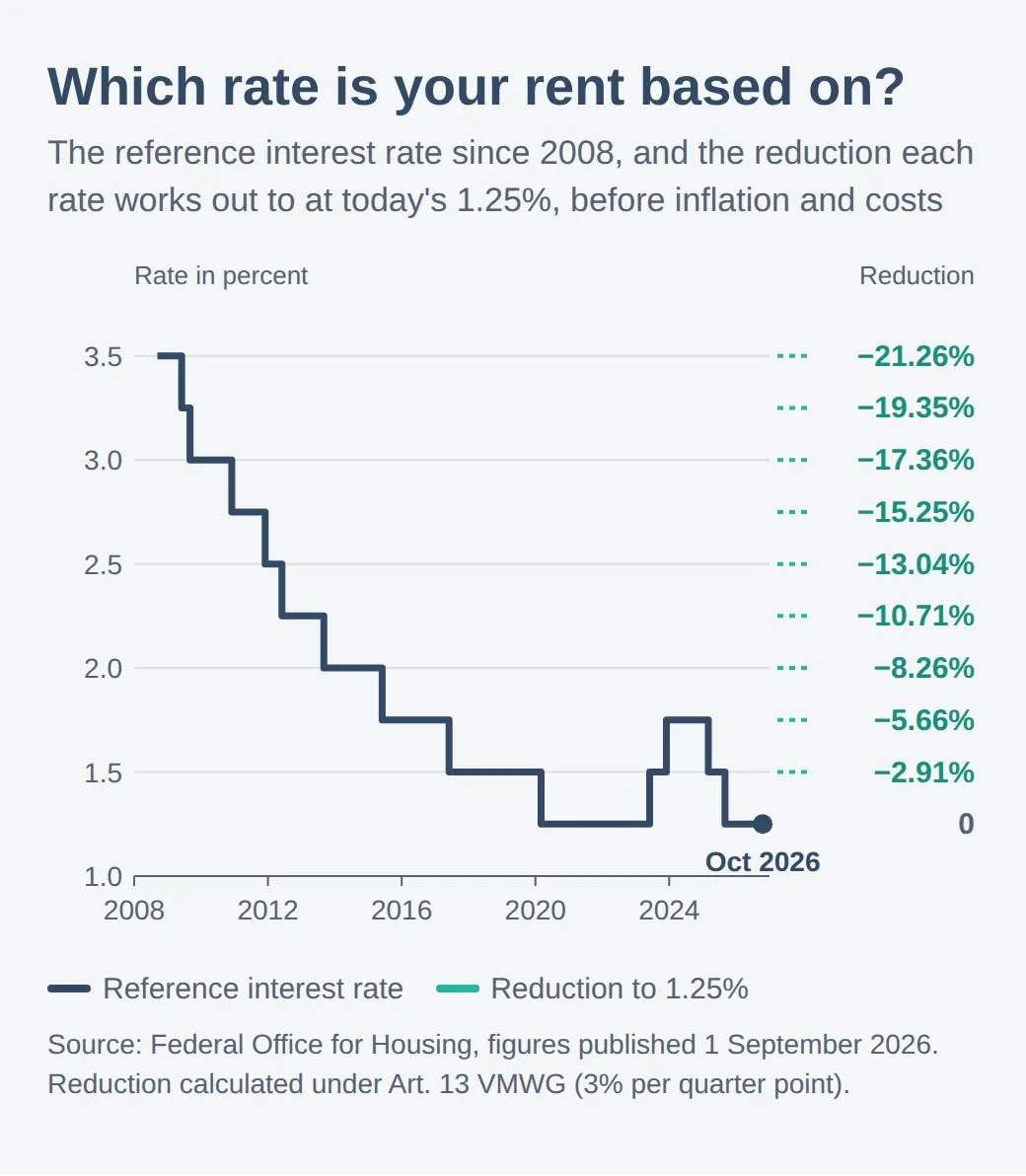
The steps show who has something to gain today. If you signed between December 2023 and early March 2025, you pay on the basis of 1.75 percent and can, on paper, ask for 5.66 percent less. Leases from the months at 1.5 percent, that is June to November 2023 and March to August 2025, give you 2.91 percent. And a lease from the first half of 2015 that was never adjusted is still based on 2 percent: that would be 8.26 percent. Across several steps the percentages are not simply added, because each reduction reverses one 3 percent increase. The table of these pass-through rates, which the FOH also refers to, is kept by the journal mietrechtspraxis (PDF in German).
These percentages are only the starting point, though. What is left in the end depends on what the landlord may set against them.
What the landlord can offset
The landlord does not have to grant the full reduction. They may offset the interest saving against cost increases since the rent was last set (Art. 13 VMWG). Three items matter most:
- Inflation: 40 percent of the rise in the Swiss Consumer Price Index since the rent was last set (Art. 16 VMWG).
- General cost increases: higher fees, insurance premiums, maintenance. In principle the landlord has to prove them. In their leaflet on rent increases (in German), the conciliation authorities in the canton of Zurich simplify this with flat rates per year: 0 percent for buildings up to five years old, 0.25 percent where many ancillary costs are billed separately, 0.5 percent where few or none are. In court, though, proof is still needed.
- Reserved increase: if the landlord did not use an earlier increase in full, they can claim the rest, provided they recorded it at the time in francs or as a percentage (Art. 18 VMWG).
Our example shows what this means in francs: an office at CHF 5,000 net a month, open-ended, lease from December 2024 based on 1.75 percent. The consumer price index stood at 106.9 points when the lease was signed (November 2024) and at 108.5 points in September 2026 (both on the base December 2020 = 100, Federal Statistical Office). For costs we assume the Zurich flat rate of 0.25 percent a year, for the roughly two years up to the request.
| Item | Rate | CHF per month |
|---|---|---|
| Reference rate 1.75 to 1.25% | −5.66% | −283 |
| 40% of inflation (106.9 to 108.5) | +0.60% | +30 |
| Cost increase, 2 years at 0.25% | +0.50% | +25 |
| Result | −4.56% | −228 |
The new rent would be CHF 4,772, or CHF 2,736 less a year. We have simply added up the items. If the landlord calculates differently, ask to see each item in francs and ask for the supporting documents.
The landlord always has one further defence: they can ask the court to check whether the current rent gives them an excessive return in the first place. In BGE 147 III 32 (in German), the Federal Supreme Court held that the landlord may always raise this as an objection, using the so-called absolute method, that is, based on their actual return. If the property earns the landlord little, a reduction can fail for that reason, even though the rate has fallen.
When this amount actually shows up on your bill is the next question, and for commercial premises that is where the biggest difference from a flat lies.
Six months' notice: when the reduction takes effect
The reduction only applies from the next possible termination date (Art. 270a CO), observing the notice period. For commercial premises, that period is at least six months, to a date set by local custom or, where there is none, to the end of a three-month period of the lease (Art. 266d CO). For a flat it is three months. If your lease sets a longer period, or only two dates a year, those apply.
For our office, which can be terminated at the end of March and the end of September, it looks like this:
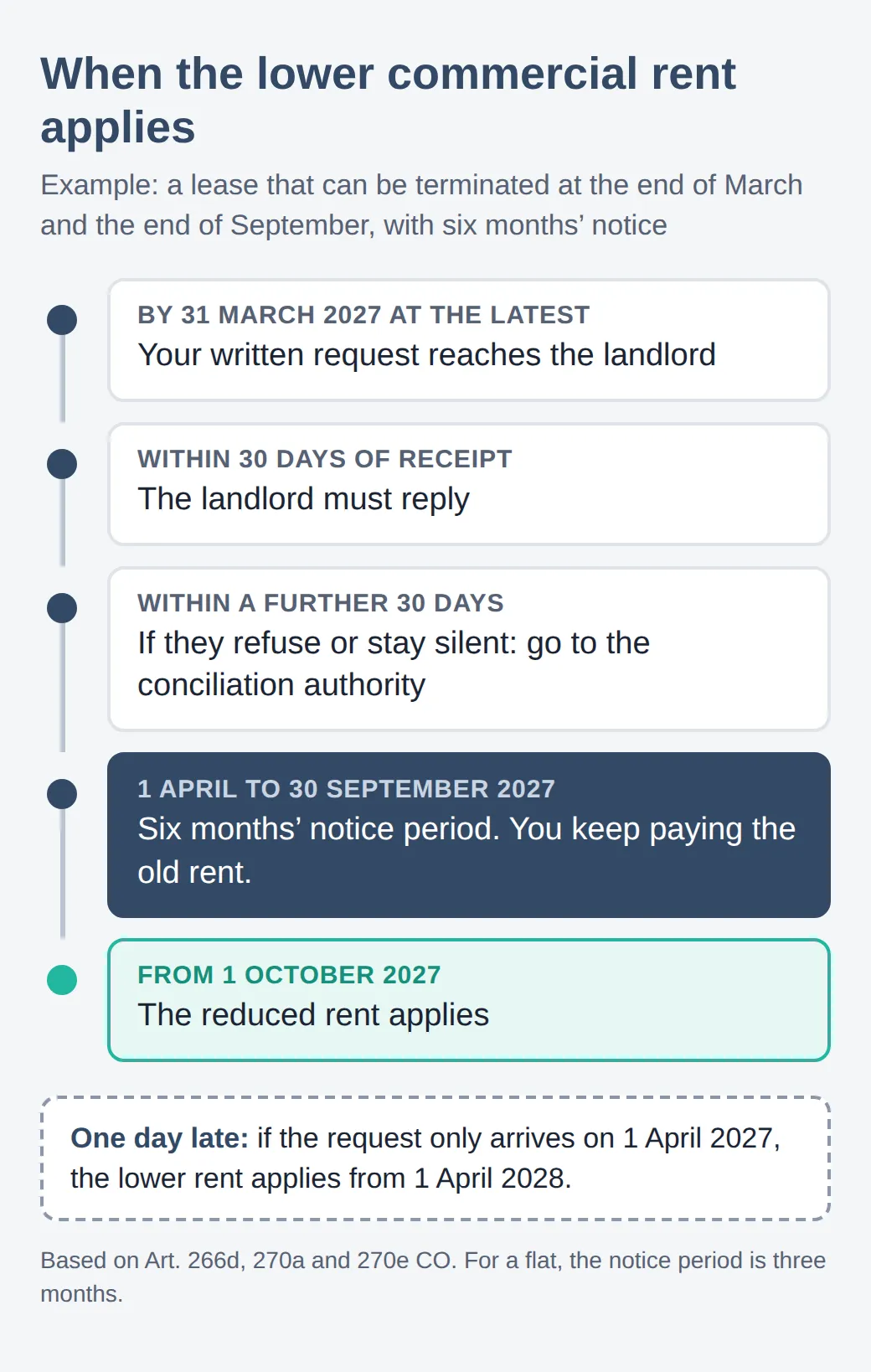
So in this example, a letter sent at the end of October 2026 only takes effect from October 2027, because the end of March 2027 date has already been missed. If you know your dates, you do not give away six months: at CHF 228 a month, that is CHF 1,368. Throughout the whole procedure you keep paying the current rent, and the lease continues unchanged (Art. 270e CO).
Writing the request for a reduction
You send the request to the landlord in writing, ideally by registered post, as the FOH recommends. You do not need a form. The landlord has 30 days to reply. If they refuse, grant only part of it or do not respond, you have a further 30 days to take the matter to the conciliation authority where the premises are located. If you miss that deadline, everything starts again with a new letter. For our example, something like this is enough:
By registered post. Request for a rent reduction under Art. 270a CO, office [address, floor, area]. Under the lease of [date], our net rent of CHF 5,000 per month is based on a reference interest rate of 1.75%. Since 2 September 2025, the rate has been 1.25%. We request a reduction of the net rent by 5.66% as of the next possible termination date. If you offset inflation, cost increases or a reserved increase against it, please provide a breakdown in francs. Please reply within 30 days. [Place, date, signature of the authorised signatory]
If your GmbH or AG is the tenant, the person authorised to sign for the company signs. And if you are worried about the relationship: a termination given because you asserted a claim in good faith can be challenged, and after conciliation proceedings that the landlord loses to a significant extent or that end in a settlement, special protection against termination applies for three years (Art. 271a CO).
With an ordinary rent, you can make such a request at any time. With an index-linked rent, by contrast, there is exactly one moment, and if you miss it, you lose the claim.
Index-linked rent: the one date at the end of the index period
If an index-linked lease continues open-ended after its fixed term, the indexation falls away and the reference rate counts again. The exception is when the landlord is again bound for at least five years for the next period: then the index may continue. That is what BGE 150 III 71, ruling 4A_252/2023 of 24 October 2023, says. You can, however, still ask for an adjustment as of the end of the first index period even if the lease automatically extends by another five years (BGE 147 III 32).
The case concerned a penthouse flat, but the rules on index-linked rents in the Code of Obligations apply equally to residential and commercial premises. A couple in the canton of Basel-Landschaft had signed an indexed lease in 2015 for CHF 3,500 net a month, fixed for five years until the end of March 2020, with the reference rate then at 2 percent. After the fixed term, the lease continued open-ended. On 4 March 2020, the tenants asked for a reduction as of July 2020 and wanted to start from the 2015 rate. After the conciliation hearing, the landlord lowered the rent to CHF 3,393. The Cantonal Court went further and set it at CHF 3,215. The Federal Supreme Court overturned that, and the rent stayed at CHF 3,393.
Its reasoning is central for every commercial tenant with an indexed lease. Adjustments, including those for the reference rate, must be requested as of the end of the index period, observing the notice period, or the claim is forfeited. If you fail to do so, you are deemed to accept the rent as it stands at that moment. What then counts is the reference rate at the point when you could have given notice in time for the end of the index period, in that case December 2019 at 1.5 percent. The reductions from 2 to 1.5 percent during the index years were lost for good, leaving a single step down to 1.25 percent.
For you, this means: count back the notice period from the end of your index period and put the date in your calendar. With ten fixed years to the end of September 2030 and six months' notice, your request must reach the landlord by the end of March 2030 at the latest. BGE 147 III 32 sets one limit here: as of that date you can only rely on the relative method, that is, on changes in costs and interest rates, not with the landlord's return.
Clauses meant to rule out a reduction
Some commercial leases try to stop the rent from ever going down: "The rent shall not fall below the initial rent." Exactly such a clause was in the lease of a hairdressing salon in Zurich that the Federal Supreme Court ruled on in 1999 (BGE 125 III 358). A shop at CHF 1,850 net a month, plus two parking spaces, terminable with six months' notice to the end of March or September, with the rent based on a mortgage rate of 6.5 percent.
In September 1997, the tenants asked for a reduction. The landlord pointed to his fixed-rate mortgage and to the clause. The Zurich rental court reduced the shop rent anyway, to CHF 1,619.30 from October 1998 and to CHF 1,584 from April 1999, and the Federal Supreme Court confirmed it: the right to a reduction cannot be excluded by contract, not even with a minimum rent equal to the initial rent. You can only waive it once you already know how things have developed, so not in advance when you sign.
The ruling leaves open only the fixed term of an index-linked lease: it notes that, under the old law, the Federal Supreme Court accepted a floor there. For the reference rate that changes little, because the rate does not count during the index period anyway. From the end of the fixed term, the ruling applies. Before you sign a new lease, it is best to strike such clauses straight away.
If the rate rises again
The mechanism works both ways, and here too the notice period sets the pace. If the landlord wants to raise the rent because of a higher reference rate, they must notify you of the increase on the form approved by the canton and give reasons, at least ten days before the notice period begins (Art. 269d CO). With six months' notice, that means at least six months and ten days before the date. Without the form or the reasons, the increase is void. You can challenge it with the conciliation authority within 30 days (Art. 270b CO).
Politically, the issue is far from settled. On 25 September 2026, the Federal Council decided (in German, French and Italian) to reject the popular initiative on rents (Mietpreis-Initiative) and to draw up an indirect counter-proposal, with a statistical benchmark rent for initial rents and indexation during the tenancy. The consultation is planned for the first half of 2027. Separately, the Federal Department of Economic Affairs, Education and Research is to present, by April 2027, an amendment to the ordinance on the permitted net return when the reference rate is above 2 percent. The announcement does not say whether the counter-proposal would also cover commercial premises. For your rent today, the rules above apply.
What to do now
Get out your lease and the last rent notice and answer three questions. Is the rent indexed, stepped or tied to turnover? Is the lease still running for a fixed term, and until when? Which reference rate is the current rent based on? If the rent is ordinary, the lease can be terminated and the rate is 1.5 percent or higher, send your request before the next cut-off, that is at least six months before your next termination date. With an index-linked rent, note the one date at the end of the index period.
And if you are thinking about moving anyway: a new lease is based on today's rate of 1.25 percent. At every viewing, ask whether the rent is indexed and how long the fixed term runs. You can find offices in Winterthur here, for example:
Commercial and industrial space across the canton is in our overview for the canton of Zurich.
Common questions
Do ancillary costs go down when the reference interest rate falls?
No. A change in the reference interest rate only affects the net rent. Heating and ancillary costs agreed separately are not touched, as the Federal Office for Housing also points out. They are billed at actual cost.
Does the reduction also cover parking spaces I rent together with my shop?
Yes, if the landlord lets them to you together with the business premises. Tenancy law for commercial premises then also covers garages, parking spaces and storage spaces. In the Zurich hairdresser case, which the Federal Supreme Court decided in 1999, not only the shop rent went down but also the rent for the two parking spaces, from CHF 100 to CHF 87.60.
Can my landlord terminate the lease because I asked for a rent reduction?
They can, but you can challenge such a termination, because all you did was assert a claim under the lease. On top of that, the law protects you for three years after conciliation proceedings in which the landlord lost to a significant extent or reached a settlement with you. Exceptions apply, for example, if you are behind with the rent or the landlord urgently needs the premises for their own use.
Does my landlord have to pass on a lower reference rate automatically?
No. In Switzerland no authority checks rents on an ongoing basis, so you have to act yourself. Some landlords pass reductions on voluntarily, but without your request they have no obligation to. If you ask for nothing, you keep paying the current rent.
More from the blog
All posts
Office rent in Zurich 2026: price per m² by area
A Zurich office costs a median CHF 250 per m² a year in Altstetten and CHF 625 in the City. Rents by area, service charges, fit-out and a worked example.

Renting practice space in Switzerland: permits and lease
What practice space for doctors, therapists and counsellors needs in Switzerland: licences, zoning, step-free access, soundproofing, X-ray and the lease.

Office rent per m² in Switzerland 2026: ten cities compared
What an office costs per m² a year: Geneva CHF 495, Bern 240, Biel 180. Asking rents, vacancy and 150 m² a month in ten Swiss cities.