Renting a shop in Switzerland 2026: footfall, rent, permits
What matters most
In Switzerland, you rent a shop under the same rules as any other commercial premises. Whether the shop pays its way, though, is not something the law decides. It depends on points you have to check yourself before you sign: how many people actually walk past, how the rent is tied to your turnover, how long you are bound, and whether you may design your shop window and sign the way you plan.
Figures from Zurich show how much a shop's success depends on its location. On Bahnhofstrasse, laser scanners have counted every passer-by since 2021. In the middle section, the average between October 2025 and September 2026 was 38,902 a day. In Lintheschergasse, a parallel street one block west of Bahnhofstrasse, it was 8,067. Both are in central Zurich, yet one street gets almost five times the footfall of the other, before you have put a single item on the shelf. We explained the rules on notice, deposits and fit-out that apply to all commercial premises in our post on the commercial lease. This one is about what makes a shop different.
Check the location: count passers-by, don't guess
Footfall is the number of people who pass a given spot in a given time. Listings almost never give it as a number, only as a promise: "high footfall", "prime location", "passing trade". Ask for figures, and where there are none, collect them yourself.
For Bahnhofstrasse, the figures are public. The City of Zurich publishes the counts made by the company hystreet as open data (in German), hour by hour, at three points on Bahnhofstrasse and, since March 2024, in Lintheschergasse. We analysed the twelve months from October 2025 to September 2026.
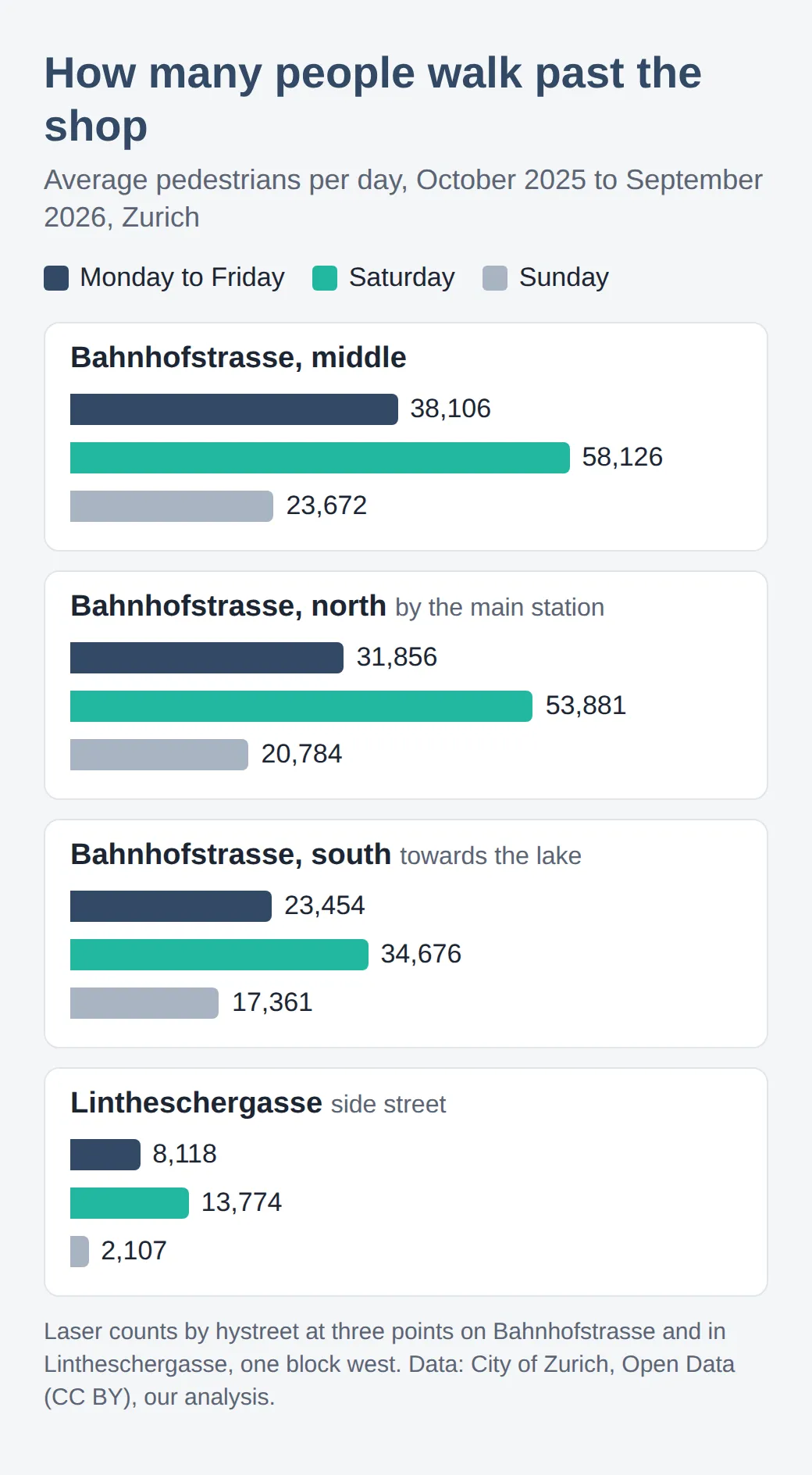
Footfall depends not only on the street but on the section of it. At the southern end of Bahnhofstrasse, around 40 percent fewer people pass on weekdays than in the middle. Saturday is the retail day: in the middle, 58,126 people pass, just over 50 percent more than on a weekday. And footfall in the side street collapses on Sundays: 2,107 passers-by against 13,774 on Saturday. A shop there that hopes to live off Sunday trade has got its sums wrong.
Factor in the time of day too. In the middle of Bahnhofstrasse, weekdays are busiest around 5 pm, with an average of 3,867 passers-by an hour; at 8 am it is 1,364. On Saturdays the peak comes in the afternoon, at 3 and 4 pm, at around 6,300 an hour. In Lintheschergasse, from 8 pm on weekdays, no more than about 160 people an hour walk by. If you are planning staffing or want to open in the evening, this gives you a first idea of whether it pays.
Even the side of the street counts. The data splits each section into zones, one for each side of the street. In the northern section near the main station, 54 percent of passers-by walk on one side and 36 percent on the other, so the better side gets half as many people again. Whenever you are given a figure, ask which side it applies to.
How to count for yourself
Most streets in Switzerland have no sensors. A simple count helps instead, and we recommend one before you sign anything. On an ordinary weekday and on a Saturday, stand in front of the shop and, during the hours you plan to open, count everyone who walks past for 15 minutes at a time. Multiply by four and you have an hourly figure. Count outside a competitor or the best shop on the street as well, so you have a comparison. And note who goes by: commuters on their way to the station buy differently from people out for a stroll.
The number alone doesn't make sales. Every person is counted, including those hurrying through. Whether anyone stops depends on the window, the entrance and how visible the shop is. The risk that the sums don't add up is usually yours, and the Federal Supreme Court made that very clear in 2025.
Who bears the risk when customers stay away
If customers stay away, you still owe the full rent. That is the basic rule, and in judgment 4A_37/2025 of 11 September 2025 the Federal Supreme Court confirmed it even for a business the authorities had closed. A tenant in Graubünden ran a club and had to close it twice during the pandemic on the Federal Council's orders, from March to June 2020 and from October 2020 to June 2021. She claimed a rent reduction of at least 50 percent, or at least CHF 34,600.55, arguing that the premises had been defective. She lost at every level, finally before the Federal Supreme Court. The closures hit the tenant's business, not the premises, and there was nothing wrong with those.
What matters for shop tenants is when the answer would be different. A defect could arise, the court said, if the landlord had taken on all or part of the risk of the business use in the contract. As examples it expressly names "the promise of a particular level of customer footfall or the agreement of a turnover rent". Merely stating the intended use in the contract, on the other hand, is not enough. So the words "retail premises for fashion" in your lease shift no risk at all.
What does this mean for your lease? If the landlord advertises footfall figures, ask to see the source. Whether a figure you write into the lease counts as a warranty in a dispute is ultimately for a court to decide, but without it you have nothing to point to. And don't expect help if the rent was simply too high for your turnover. As early as 2000, in judgment 4C.156/2000, the Federal Supreme Court held that courts do not, as a rule, review whether what the parties agreed is fair value. The only exceptions come through special rules such as challenging the initial rent. If you want to share the risk, you have to write it into the lease, and the best-known way to do that is a turnover rent.
What is a turnover rent?
With a turnover rent, you pay a share of your turnover as rent, often with a fixed minimum rent as a floor or on top of a fixed base rent. The tenancy law in the Code of Obligations does not mention it at all; it covers only index-linked and stepped rents. Everything about a turnover rent is therefore down to the lease, and every gap gets expensive in a dispute.
The case behind the 2000 judgment shows what such a formula looks like. A restaurant with a dance floor in Chur first cost CHF 17,250 a month, service charges included, plus VAT. When the tenant fell behind with the rent, the parties agreed a turnover rent in 1996, which in its October 1996 version read: 20 percent of gross turnover from the month before last, at least CHF 6,000 and at most CHF 17,250, excluding VAT. The arrangement was to be reviewed after 24 months. That never happened, and the courts ruled that the old fixed rent applied again from then on. The turnover rent had been meant as temporary relief, so it ended even though the agreement gave no end date. Spell out in the lease how long a turnover rent applies and what comes after it.
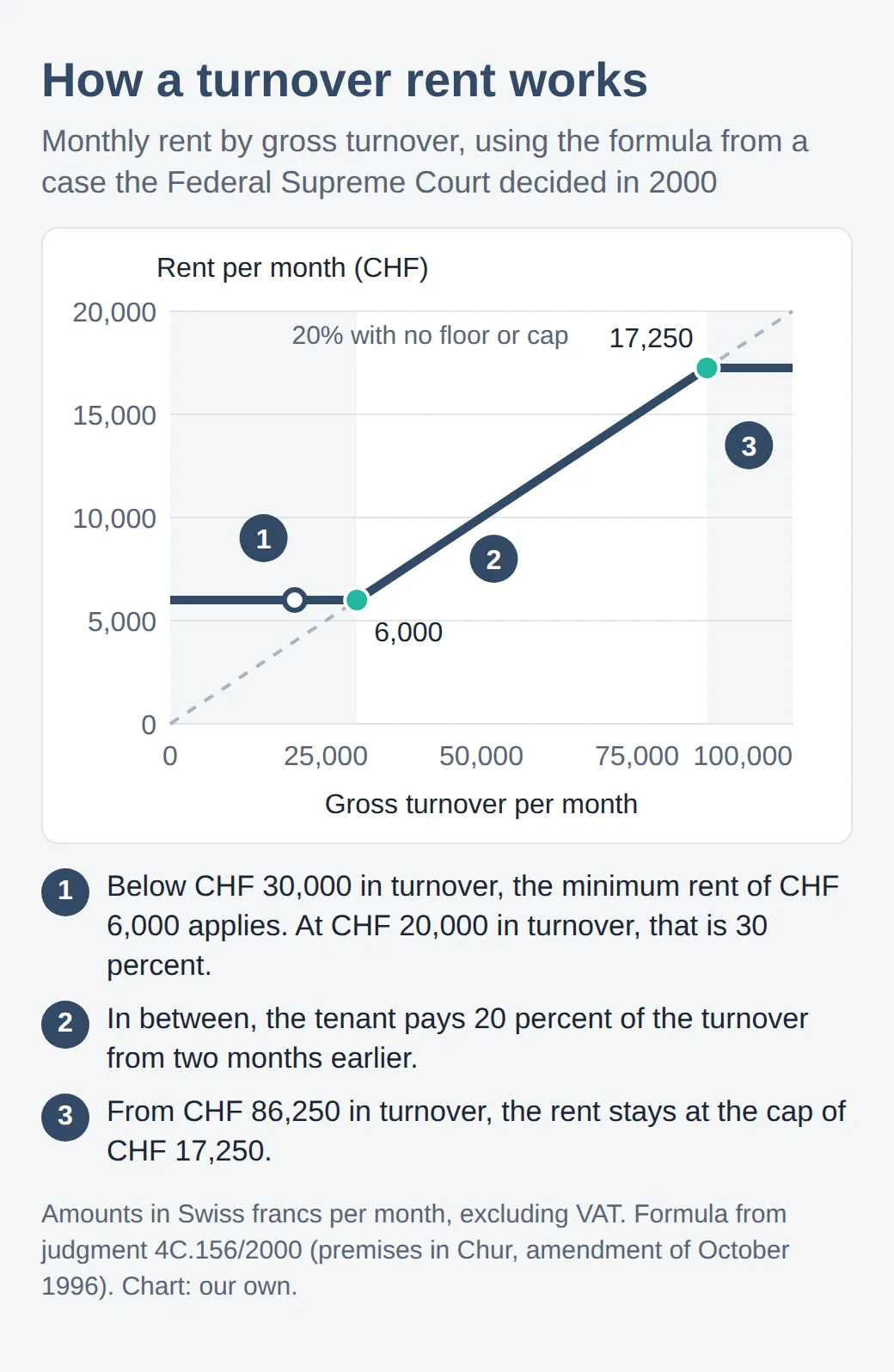
The chart shows where a turnover rent helps and where it doesn't. In a weak month with CHF 20,000 in turnover, the tenant pays the minimum rent of CHF 6,000, which is 30 percent rather than 20. The percentage only kicks in from CHF 30,000. From CHF 86,250 in turnover, the rent stays at the cap, and every further franc goes entirely to the tenant. So the level of the minimum rent matters at least as much as the 20 percent. If it is as high as a normal fixed rent, the turnover rent is just a surcharge for good months.
Just as important is what counts as turnover. Settle in the lease whether it is gross or net, with or without VAT, what happens to returns, vouchers and discounts, and whether orders paid online and collected in the shop count. Set out which records the landlord may see, and that they must keep the figures confidential.
And meet the reporting deadlines. Judgment 4A_492/2009 shows how strictly they are enforced. The tenants of a shop in the canton of Zurich, who ran a pharmacy there, had fallen behind with the rent. In the dispute over the termination, they reached a settlement with the landlord in which they undertook to report their turnover in writing every quarter by the 10th of the following month and to send an annual turnover rent statement by 10 October 2006. In return, the landlord was to waive CHF 49,123.50 of old rent arrears. The tenants paid the agreed CHF 50,000 and their current rent on time. But they sent the turnover figures a month after the deadline, which had already been extended, and sent them by unsigned email without a proper statement. The waiver lapsed, and the Federal Supreme Court dismissed their appeal in 2010. A signed statement sent on time would have saved them CHF 49,123.50.
How long are you tied in?
Commercial premises are often let for a fixed term of many years. The homeowners' association HEV Region Winterthur (in German), which speaks for landlords, writes that commercial leases are often concluded for ten years, with an option to extend, usually for another ten. There is no statutory minimum term. In practice, one arises indirectly: a rent indexed to inflation is valid only if the lease runs for at least five years (Art. 269b CO). A stepped rent, which rises by a fixed amount no more than once a year, requires at least three years (Art. 269c CO).
For the landlord, a long commitment means security. For a new business it is a risk, because whether a shop works in a location often shows in the first or second year. Ten fixed years then means nine years of rent for a location that isn't working. So negotiate a shorter fixed term with an option to extend that only you can exercise, or ask for a one-off right to terminate after a few years. Such clauses exist. In a Zurich lease for a restaurant with shop premises, which the Federal Supreme Court ruled on in 2011 (4A_195/2011), the lease could not be terminated before 31 March 2015, except through a one-off right to terminate on 31 March 2010. But that right belonged to the landlord. Ask for it for yourself.
If things still go wrong, you have a way out that exists only for commercial premises. You can transfer the whole lease to a successor, for example when you sell the business with its fittings (Art. 263 CO). The landlord must consent in writing and may refuse only for good cause. You then remain jointly and severally liable for no more than two years. Many leases attach conditions to a transfer, such as balance sheets or a new deposit. Read that clause before you need it.
Which permits does a shop need?
You need no permit to rent the premises. For what you do in them, you often do, and the municipality is usually in charge. There are three questions to settle before you sign.
The first is the use. If the space is an office, a practice or a storeroom today, your shop turns it into something else. The City of Zurich says that changes of use (in German) usually need a building permit, especially when the change matters under building law. Ask the landlord what use the premises are approved for, and ask to see the permit. Make the lease conditional on any permit you need being granted. Otherwise you will be paying rent for a shop you are not allowed to open.
The second concerns food. Anyone who handles food must notify the cantonal enforcement authority under the federal food ordinance (Art. 20 LGV, published in German, French and Italian only), and that includes a bakery branch, a kiosk or a delicatessen. The City of Zurich sorts food businesses (in German) into several categories. A food shop has no seating for guests, needs toilets for staff and, if it runs a commercial kitchen, mechanical ventilation. Put out tables for guests and it becomes a different kind of business with different requirements. Whether ventilation can be fitted in the building can therefore decide the whole plan.
The third concerns everything customers see from outside. Here the cities differ so much that it needs a section of its own.
Shop windows and signs: two cities, two sets of rules
A sign and a shop window are to a shop what the address is to an office. Whether you need a permit for them is a matter for cantonal and municipal building law, and even Zurich and Basel take opposite approaches to the shop window.
In the city of Zurich, almost every sign needs a permit. Under the canton's Planning and Building Act, the only exemption is one unlit sign per business of up to 0.5 square metres on private ground, and not even that in historic core zones or on protected buildings. For shop windows, the city is stricter still.
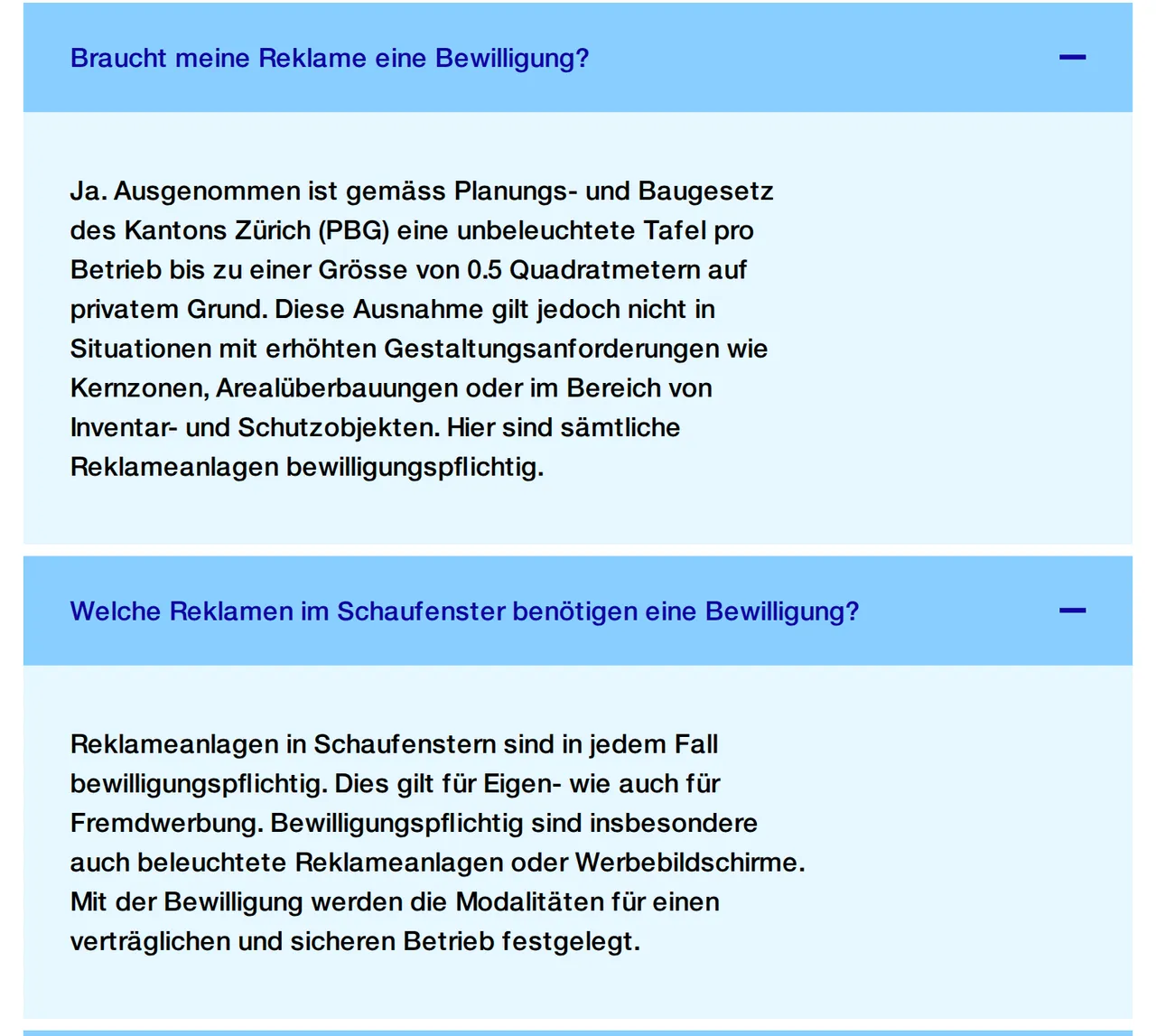
"Advertising installations in shop windows require a permit in every case," the city writes in its questions and answers (in German), and that includes advertising for your own business. You submit applications through the canton's eBaugesucheZH platform. A preliminary enquiry is free and usually answered within 14 working days; the permit procedure usually takes 30 days from submission. The permit costs a one-off fee. If your sign projects into public space, for example as a bracket sign over the pavement, an annual concession fee comes on top.
In Basel-Stadt, outdoor advertising also generally needs a permit. But the canton makes two important exceptions for shops, as its building and hospitality inspectorate, the Bau- und Gastgewerbeinspektorat (in German), explains. Unlit company lettering of up to 0.5 square metres per business needs no permit in the normal, numbered building zones, and in conservation and protection zones it only has to be notified. And "advertising film applied to the inside of shop windows" needs no permit either. Film stuck to the outside of the window, up to 12 square metres, is checked in a simplified procedure. The fee depends on the area, doubles for illuminated signs and quadruples for third-party advertising.
What this means for you: plan your sign, illuminated lettering and window film together with the lease, not after you get the keys. In Zurich, allow a month for the permit. And don't forget the landlord. A sign on the façade is a change to the rented property, so you need their written consent (Art. 260a CO). Once they have consented, they can only make you take it down at the end if that was agreed in writing. So put the size and position of the sign in the lease, along with the right to light it.
One shop-window rule applies everywhere in Switzerland. If you display goods there, their prices must be easy to read from outside (Art. 8 PBV, in German). A display without legible prices breaches the Price Disclosure Ordinance.
Before you sign
A shop is a bet on a location, and the rent is its biggest fixed cost. Checking things in the right order therefore saves money. Count first, before you talk about price: if the figures can't carry your business, any further negotiation is wasted time. If they can, check with the municipality whether the use is approved, and send a preliminary enquiry for your signage, which in Zurich is free and usually answered within 14 working days. Use the wait to draft the lease, starting with the clauses that decide your risk: minimum rent, fixed term, sign.
Only sign once the municipality has answered, or make the lease expressly conditional on the permit. You'll find commercial space in the city of Zurich here:
In Basel, where you can put film on the inside of your shop window without a permit, this is what's on offer:
Common questions
Do I need a permit for an A-board on the pavement in Switzerland?
Assume you do. A board in front of a shop usually stands on public ground, and in the city of Zurich anyone using public ground for advertising needs a concession under the city's rules on advertising installations on public ground, with a fee due every year. The same applies to a sign that projects over the pavement, because the airspace above the street counts as public ground too. Ask your municipality before you buy a board.
Can I serve coffee in my shop?
Not automatically. The City of Zurich treats a shop with a refreshment corner as an ancillary restaurant business, one attached to another business, and businesses that serve food or drinks need a licence. A food shop with no seating for guests falls into a different category. Settle this before you sign the lease, because it can bring building requirements such as toilets or ventilation.
Can a shop open on Sundays in Switzerland?
It depends on the canton and on who works in the shop. The Employment Act bans employing staff between 11 pm on Saturday and 11 pm on Sunday, and cantons may designate at most four Sundays a year on which shops can employ staff without a permit. If only you and close family members work in the shop, the Act does not apply. Opening hours themselves are set by cantons and municipalities, in Basel-Stadt for example by its law on public holidays and shop opening hours.
Can I challenge my shop rent if it turns out to be too high?
You can challenge the initial rent before the conciliation authority within 30 days of taking over the premises, but only under certain conditions: the rent must be unfair, and you must have been forced to sign by hardship or by the state of the local market, or the rent must be much higher than the previous tenant's. Turnover falling short of your expectations later is not a ground. Courts do not check whether an agreed rent suits your turnover.
More from the blog
All posts
Buying a restaurant in Switzerland: price, lease and permit
What the price for a restaurant takeover pays for, how the lease passes to you under Art. 263 CO, and why you always apply for the permit yourself.
Commercial lease in Switzerland 2026: what to negotiate
Six months' notice, no cap on the deposit, index-linked or stepped rent, options, restoration: what a Swiss commercial lease says and what you can negotiate.
Renting practice space in Switzerland: permits and lease
What practice space for doctors, therapists and counsellors needs in Switzerland: licences, zoning, step-free access, soundproofing, X-ray and the lease.