Buying a restaurant in Switzerland: price, lease and permit

Before the handshake
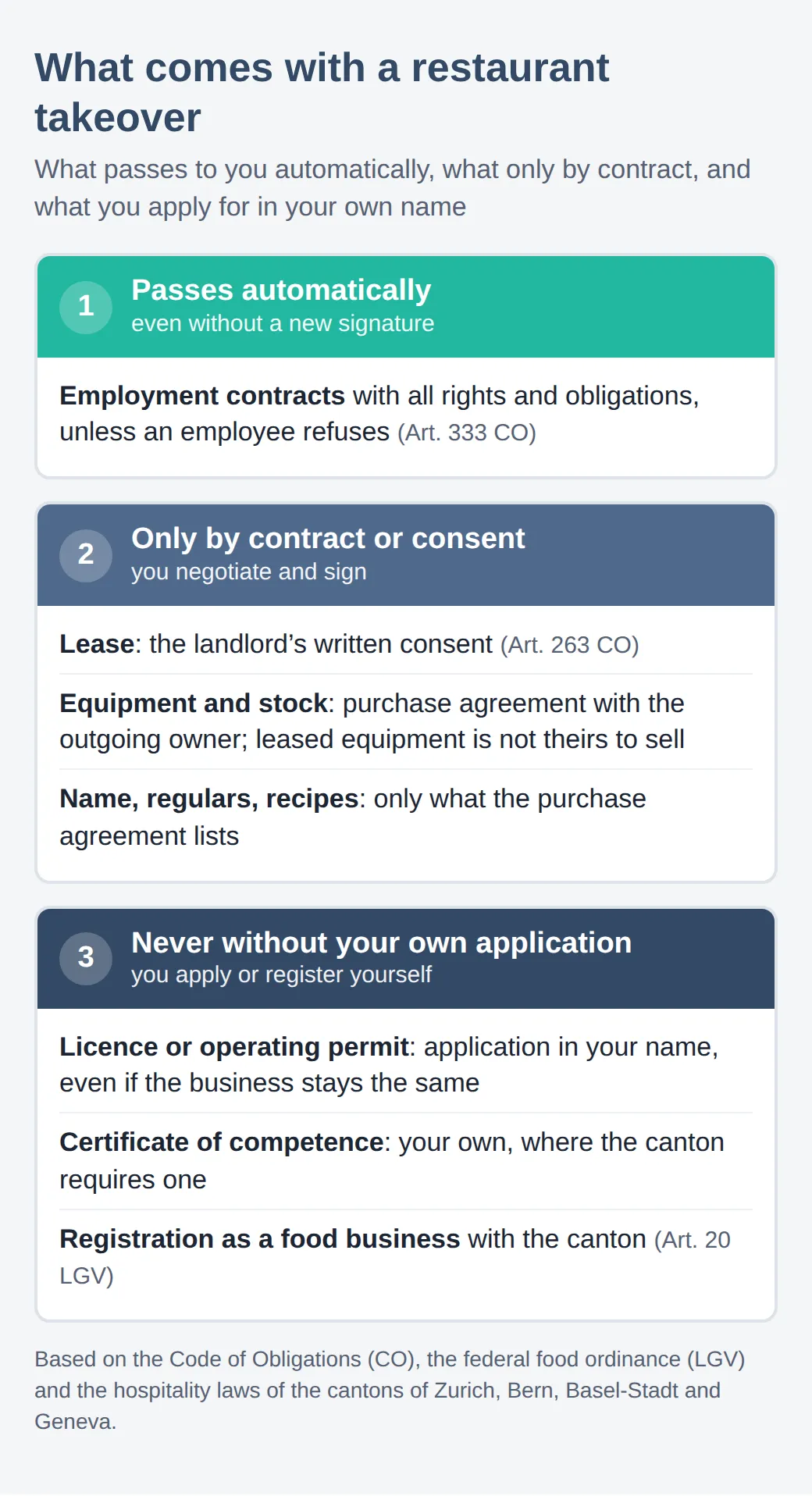
With the takeover price, you pay the outgoing owner for what they leave you: equipment, stock, the name and the regulars. The lease can only pass to you with the landlord's written consent (Art. 263 CO). And the licence or operating permit never passes to you by itself: in Zurich, Bern, Basel and Geneva you file your own application, even if the business stays exactly the same.
That leads to the key question in any takeover. It isn't whether the asking price is fair, but what the money pays for and how much of it you'll actually own at the end. Taking over a restaurant means negotiating with four parties at once: the outgoing owner, the landlord, the authorities and the staff who already work there. Each has its own rules, and with only one of them does anything pass to you automatically.
How a commercial lease works in general, with its option, deposit and notice, is covered in our post on the commercial lease. This one is about what a takeover adds.
What the takeover price pays for
The takeover price, known in German-speaking Switzerland as the Ablöse, is not a legal term. Neither the Code of Obligations nor the federal lease ordinance uses the word, and "key money" (Schlüsselgeld) appears nowhere either. Legally, it is an ordinary purchase agreement between you and the outgoing owner. What you buy is set by that agreement alone. If all it says is "takeover of the restaurant, CHF 120,000", you'll have very little to go on later.
A sound takeover price breaks down into three parts. The first is the equipment: kitchen appliances, cold rooms, furniture, tableware, the till. The second is the stock, counted on handover day and charged at cost. The third is goodwill, meaning everything you can't touch: the name, the regulars, the recipes, the website, perhaps a lunch menu that sells well. Each part should carry its own price in the agreement, and the equipment ideally comes with a list, item by item.
If a large sum is left once you deduct equipment and stock, what you are really paying for is the location and the running lease. This is where it gets delicate, because some landlords expressly forbid that in the lease. A published draft commercial lease from the town of Illnau-Effretikon (in German) shows how this looks in the small print. It prohibits a "Handgeld (Schlüsselgeld oder ähnliche Entschädigung für die Übertragung des Mietvertrages ohne adäquate Gegenleistung)", that is, key money or any similar payment for transferring the lease without adequate consideration. If one is agreed anyway, the landlord may refuse consent to the transfer. If the landlord only finds out later, they may terminate the lease and claim a contractual penalty of at least six months' rent.
The same draft requires the tenant to give the landlord copies of every agreement with the successor, together with a detailed list of the fit-out, fixtures and appliances taken over. So expect your purchase agreement to land on the landlord's desk. A price you can justify with an inventory list and turnover figures stands up to that scrutiny. A round sum with nothing behind it doesn't.
For the landlord, the law draws a clear line. A tie-in transaction is void if the landlord makes signing or continuing the lease conditional on you taking on an obligation that isn't directly connected with the use of the premises (Art. 254 CO). The ordinance names buying furniture or taking out insurance as examples (Art. 3 VMWG, in German). This also applies when the obligation is owed to a third party: if the landlord makes the lease conditional on you buying the outgoing owner's furniture, that condition is void. What you choose to pay the outgoing owner for their equipment, on the other hand, is an ordinary purchase. The next section shows how to check its price.
Is the equipment worth the money?
There is no official price for a used commercial kitchen. There is a useful yardstick, though: the depreciation rates of the Swiss Federal Tax Administration (FTA). Its Notice A 1995 (in German) sets the standard rates at which businesses write down their assets for direct federal tax, a fixed percentage of the remaining book value each year. For business furniture it is 25 percent, for equipment and machinery used in production 30 percent, and for hotel and restaurant tableware and linen 45 percent. Goodwill is written down at 40 percent.
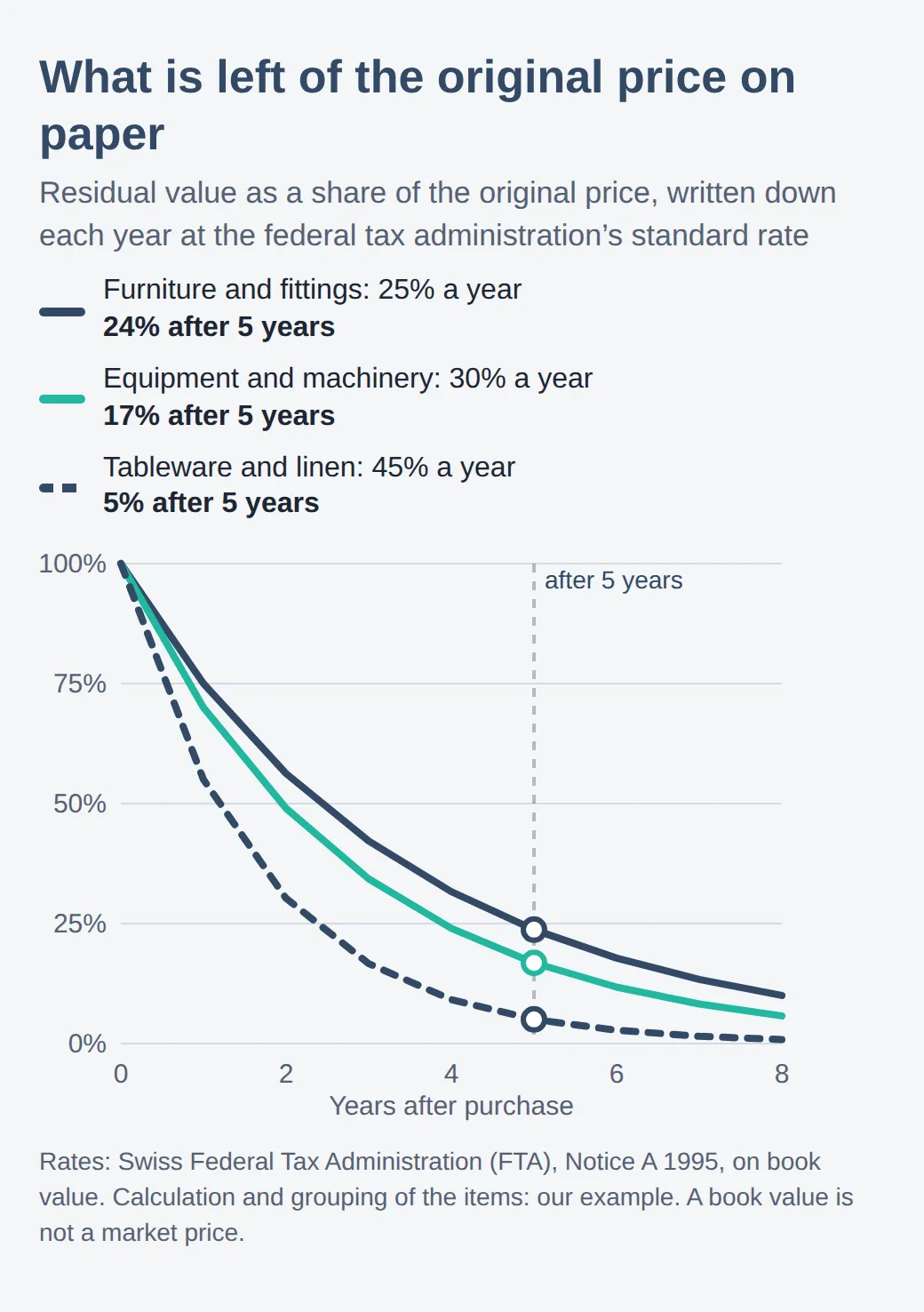
A worked example shows what this means. An outgoing owner asks CHF 120,000. According to their invoices, five years ago they spent CHF 90,000 on kitchen equipment, CHF 60,000 on furniture and fittings and CHF 15,000 on tableware and linen. If you count the kitchen equipment as equipment and machinery used in production, the FTA rates leave about CHF 15,100, CHF 14,200 and CHF 750 on paper, roughly CHF 30,100 in all. So the remaining CHF 90,000 or so pays for goodwill and location.
A book value isn't a market price. A well-kept combi steamer can be worth more than its book value after five years, while an extractor hood that has to be replaced at the next inspection can be worth less. But the calculation shows you where to look more closely. For the goodwill, ask for the annual accounts and VAT returns of the last few years, since they show the turnover the outgoing owner declared themselves. And ask the outgoing owner to show you the latest food inspection report. It lists what the inspectors objected to and what may soon need fixing, at your expense.
Check, too, whether the equipment actually belongs to the outgoing owner. Leased items, such as a coffee machine or a till system, belong to the leasing company. If the owner bought something in instalments, the supplier's reservation of ownership only takes effect if it is entered in the register kept by the debt enforcement office where the buyer lives (Art. 715 CC). An extract from that register and from the outgoing owner's debt enforcement register shows you whether suppliers or other creditors still have claims. Then there is the landlord, who holds a lien on the furnishings in the premises as security for a year's overdue rent and the current six months' rent (Art. 268 CO). If the outgoing owner owes rent, the landlord can hold back exactly the things you want to buy. So get written confirmation that no rent is outstanding before you pay.
Taking over the lease: Art. 263 CO
Without the premises the equipment is worth little, so the lease belongs right at the start. For commercial premises, the law allows something it doesn't allow for flats: the tenant can transfer the whole lease to a third party (Art. 263 CO). The landlord has to consent in writing and may refuse only for good cause. Once they consent, you take the outgoing tenant's place, with every term the lease contains.
The law doesn't say what counts as good cause. The Effretikon draft shows what landlords ask for when they check a successor: a solvency certificate from a bank, balance sheets and income statements for the last three financial years, debt enforcement register extracts covering at least three years, a commercial register extract and a new deposit. Under that draft, the landlord may refuse consent in particular if the successor wants to use the premises differently from what was allowed so far, or has to alter them for the new use. If you want to turn a pizzeria into a bar, clear that with the landlord before the transfer. Hand in a complete set of documents, and the landlord will find it hard to point to good cause.
For the outgoing tenant, the transfer has a catch that works in your favour. They remain jointly and severally liable with you until the lease ends or could have been terminated, but for two years at most. For that period the landlord has two debtors instead of one, an argument you can use when you ask for consent.
Before you accept a price, read the lease you are taking over. How long does the fixed term still run, is there an option to extend, and is it a genuine option or a non-genuine one? A takeover price of CHF 90,000 for goodwill and location is money poorly spent if the lease ends in two years with no option. Also ask whether the outgoing tenant altered the premises and has to restore them when the lease ends. You take on that duty with the lease, and the Effretikon draft even requires the agreement with the successor to say so expressly.
The other route is a new lease directly with the landlord. You then negotiate rent, term and option from scratch, and the outgoing tenant terminates their own lease. That can work out better, for example when the existing lease is about to expire. But it can also cost more, because the landlord may use the chance to raise the rent. For the value of the takeover price this is decisive: a new lease at a higher rent takes away part of what the goodwill is worth.
Rented premises or a leased business?
Some restaurants aren't rented but leased as a going concern, which Swiss law calls a usufructuary lease (Pacht). Here the lessor hands over not just premises but something that produces income, such as a fitted-out business with kitchen and furniture (Art. 275 CO). Little changes for the transfer: for commercial premises, Art. 263 CO applies to usufructuary leases too. But whatever the lessor leased out along with the premises doesn't belong to the outgoing operator, and they can't sell it to you.
Under a usufructuary lease, the parties give each other a signed inventory of the equipment and supplies and value it together (Art. 277 CO). If the inventory was valued at handover, at the end you return items of the same type and estimated value, or pay for the shortfall (Art. 299b CO). A broken dishwasher that isn't listed as faulty when you start can therefore cost you money when you leave. Go through your predecessor's inventory line by line before you take it over.
The staff come with it
If you take over a running business, the employment relationships pass to you automatically, with all their rights and obligations (Art. 333 CO). So you can't choose your team, and existing wages and arrangements continue to apply. If a collective labour agreement covers the staff, you have to abide by it for one year, unless it expires sooner. Anyone who doesn't want to move across can refuse the transfer. Their employment then ends after the statutory notice period, and until then you and that person are both bound by the contract.
You and the outgoing owner are jointly liable for employees' claims that fell due before the transfer. The same goes for claims falling due afterwards, up to the date the employment could normally have ended. A waiter with 20 days of unused holiday is your concern too. Ask the outgoing owner for a list of all staff with their wages, start dates and outstanding holiday and overtime, and offset outstanding claims against the takeover price.
The outgoing owner has to tell the staff about the reason for the transfer and its consequences in good time beforehand (Art. 333a CO). If changes are planned because of the transfer, such as new working hours, the staff must be consulted before the decision is made. Talk to the team before the agreement is signed. People who only find out on handover day that the boss is changing are more likely to quit.
Licence and permit: always in your name
The right to run a restaurant doesn't pass to you with the purchase agreement, whatever you pay the outgoing owner. In all four cantons whose rules we read, a new operator needs their own application. How high the bar is, though, varies a great deal. And the German word Wirtepatent means different things from canton to canton: in Zurich it is the licence itself, in Basel the certificate of competence you need to get the permit.
| Canton | Certificate needed? | Permit when the operator changes | Where, how long |
|---|---|---|---|
| Zurich | no | licence is personal, not transferable | municipality; provisional licence possible |
| Bern | yes, certificate of competence; up to a year to obtain it | authority transfers it on application | municipality, decided by the district government office; apply about a month ahead |
| Basel-Stadt | yes, certificate of competence | personal, not transferable | about a month, CHF 600 |
| Geneva | yes, diplôme de cafetier | new permit; if owner and operator both change, the premises stay closed until then | up to two months |
In the canton of Zurich, the licence is issued to the person responsible for running the business and can't be transferred (§ 7 of the Hospitality Act, in German). It only covers the approved premises. Zurich doesn't require an exam: you must have legal capacity, and the licence is refused if you clearly offer no guarantee of running the business properly. The municipality is in charge, and until the procedure is complete it can issue a provisional licence. If you serve spirits, you also pay the municipality a levy of between CHF 200 and CHF 8,000, charged every four years.
In the canton of Bern, the operating permit applies to a specific property (Art. 6 GGG, in German). Every business, though, is run by a responsible person who as a rule needs a certificate of competence for the hospitality trade. You get it by passing the exams for two GastroBern foundation seminars, one on food law and hygiene and one on law (Art. 18g GGV). When you apply to the municipality to take over an existing business, enclose the existing permit, a copy of your certificate and an extract from the criminal record. If you run the business as an employee, add your employment contract, and if the owner hasn't signed the application, proof that you are entitled under civil law to run it. As a rule, file the application one month before the planned opening (Art. 26 GGV). The authority then transfers the existing permit to you as the responsible person (Art. 32 GGG). If you don't have the certificate yet, it gives you no more than a year to obtain it, unless the same business already had such a grace period in the last five years.
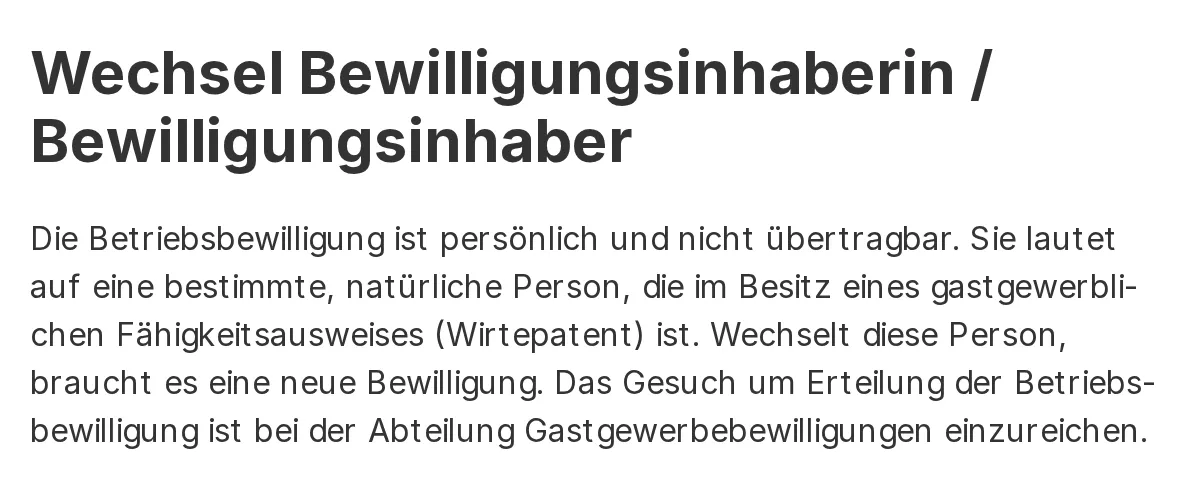
Basel-Stadt is the most explicit. The permit is issued to an individual holding a Wirtepatent, and if that person changes, a new permit is needed (page of the hospitality permits section, in German). With complete documents, the canton expects to decide within a month, and the permit costs CHF 600. One point matters for the handover: the previous operator remains responsible until they deregister in writing or a new permit is issued. If only the company changes, for example to a new GmbH (limited liability company), while the responsible person stays, the permit has to be amended too.
In Geneva, you first have to pass the diplôme de cafetier. If both the owner and the operator change in a sale, the premises must close until the new permit is granted, according to the canton (page in French). If only the operator changes, the new one files an application within 60 days of the previous operator reporting their departure. The authority replies within two months of receiving the complete file. If the premises were closed for at least twelve months before the takeover, it counts as opening a new business.
Allow time for all this. A certificate of competence takes courses and exams, and in Basel and Geneva you need to hold it before the permit can be issued in your name. You also have to register the business with the cantonal food inspectorate, because anyone handling food must report it (Art. 20 LGV, in German). In the canton of Zurich, you report an existing business as a change within 14 days, and online you can only do so with the business number issued by the Cantonal Laboratory (in German). It appears on the inspection report, which you should ask the outgoing owner for anyway.
What goes into the purchase agreement
Everything so far comes together in one document: the purchase agreement with the outgoing owner. Its most important sentence is a condition. Don't pay before the landlord has consented and the permit is in your name. Otherwise, in the worst case, you own a kitchen in premises you aren't allowed to use. The clause can be short:
This agreement takes effect only once the landlord has consented in writing to the transfer of the lease to the buyer and the operating permit for the restaurant has been issued or transferred to the buyer. If either condition is not met by [date], the agreement lapses and any payments already made are refunded in full.
The agreement should also contain an inventory list with individual prices, the rule for valuing the stock on the cut-off date, the staff list with outstanding holiday and overtime, and a statement from the outgoing owner that the equipment belongs to them and is free of leasing and reservation of ownership. The checklist from GastroSuisse, the industry association (in German), lists further points to settle with the outgoing owner: apportioning licence fees and insurance premiums already paid, subscriptions, service contracts and the oil tank, plus the contracts for leased equipment and the drinks supply.
Two legal points are worth knowing. If you buy only individual assets, you aren't liable for the outgoing owner's other debts. If, however, you take over a business with its assets and liabilities and notify the creditors or announce it publicly, you are liable for its debts (Art. 181 CO). If the outgoing owner's business is entered in the commercial register, the Mergers Act applies instead. And if both sides are registered for VAT, the sale of a business has to go through the notification procedure when the tax on the purchase price exceeds CHF 10,000 (Art. 38 VAT Act). The tax is then not charged; the sale is only reported, and you take over the outgoing owner's assessment basis for the assets you bought. Discuss both points with your fiduciary before you sign.
Do it in this order
A takeover gets expensive above all when the steps happen in the wrong order: the price is agreed on a handshake, and only then does it turn out that the lease ends in two years or the certificate of competence is still missing. So start with what you can't negotiate. Read the lease for its term, option and restoration duty. Ask the municipality or the canton which permit and which certificate you need and how long they take. Only then check the equipment, the turnover and the inspection report, and set a price that breaks down into its parts.
Sign the purchase agreement subject to the condition above, submit your file to the landlord and apply for the permit. On handover day, count the stock, go through the inventory list item by item and photograph the condition of everything. If you don't have premises in mind yet, our pages list commercial spaces that may suit a restaurant, for example in Basel:
Or in Bern, where the permit is tied to the property, so it is worth asking what type of business is already permitted there:
In French-speaking Switzerland, have a look at commercial spaces in Geneva, with the longer permit process in mind. Whatever you take over, pay for what the agreement lists and what will belong to you afterwards, not for a key.
Common questions
Can the landlord raise the rent when a restaurant lease is transferred?
Not through the transfer itself. If the landlord consents, you step into the existing lease, with the rent and notice periods it already sets out. It is different if the landlord signs a new lease with you instead of agreeing to a transfer: then everything is renegotiated, the rent included.
Am I liable for the previous owner's debts when I buy a restaurant?
If you only buy the equipment, stock and goodwill, usually not. If you take over a business with its assets and liabilities and notify the creditors or announce it publicly, you are liable for its debts, and the previous owner stays liable alongside you for three years. Staff are different: if you take over the business with its employees, you and the previous owner are jointly liable for their claims that fell due before the change.
Do I need a licence for a small café that doesn't serve alcohol?
Usually yes, with exceptions. In the canton of Zurich, small alcohol-free businesses with no more than ten seats or standing places are exempt from the licence requirement. In the canton of Bern, the authority can waive the certificate of competence in special cases, for instance when a business serves no food. Check with your municipality before you count on an exception.
What can I find out about the previous lease when I lease a restaurant as a going concern?
More than an ordinary tenant can. If you take on a restaurant as a going concern, the lessor must let you see the handover report on request, if one was drawn up when the previous lease ended, and you are entitled to know what the previous rent was. Both help you judge the condition and the price before you sign.
More from the blog
All posts
Renting a shop in Switzerland 2026: footfall, rent, permits
Renting a shop in Switzerland: reading footfall counts, turnover rent in francs, minimum lease terms, permits for signs and shop windows, with court rulings.

Renting practice space in Switzerland: permits and lease
What practice space for doctors, therapists and counsellors needs in Switzerland: licences, zoning, step-free access, soundproofing, X-ray and the lease.

Office rent per m² in Switzerland 2026: ten cities compared
What an office costs per m² a year: Geneva CHF 495, Bern 240, Biel 180. Asking rents, vacancy and 150 m² a month in ten Swiss cities.