Commercial lease in Switzerland 2026: what to negotiate
The short answer
Commercial space in Switzerland is let under the same tenancy law as flats, with a few differences that cost real money: six months' notice instead of three, no cap on the deposit, extensions of up to six years and the right to hand the lease over to a successor. Almost everything else is set by your lease. That is why you negotiate before you sign, not after.
A real example shows how much the lease itself decides. The town of Illnau-Effretikon has published the draft lease (in German) for office space it plans to rent in a new building: 316 square metres on the ground floor at CHF 290 per square metre per year, or CHF 7,636.65 net a month plus CHF 750 on account for service charges. Fixed until 2036, with an option to 2046, fully indexed, and with a bill of CHF 100,000 if the town does not take up the option. We go through the lease clause by clause, alongside what the law says. The articles come from the Swiss Code of Obligations (CO) and the Ordinance on the Lease and Usufructuary Lease of Residential and Commercial Property (VMWG, published in German, French and Italian only), as they stand today. The English text of the Code on Fedlex is a translation for information; only the German, French and Italian versions are legally binding.
How commercial premises differ from flats
Most of the protections apply to both. If you rent an office, a shop, a workshop or a warehouse, you can challenge an unfair rent, contest a termination and report defects just as a tenant of a flat can. The deadline for rent arrears is also the same: before the landlord can terminate over unpaid rent, they must give you at least 30 days in writing to pay. And a lease for commercial premises cannot change, to your disadvantage, the landlord's duty to hand over the premises fit for use and keep them that way (Art. 256 CO).
The differences are few, but they hit exactly the points where the money is:
| Rule | Flat | Commercial premises |
|---|---|---|
| Notice period | 3 months | 6 months |
| Deposit | at most 3 months' rent | no cap |
| Extension | at most 4 years | at most 6 years |
| Transfer of the lease | not provided for | allowed, with consent |
On top of that comes the landlord's special lien: a landlord of commercial premises may hold back movable property on the premises that furnishes them or is needed to use them, as security for a year's rent in arrears and the current half-year's rent (Art. 268 CO). Goods your creditors could not seize are exempt. For flats, this right does not exist.
The biggest difference, though, is in practice rather than in any article: commercial premises are often let for a fixed term of many years. The landlord association HEV Region Winterthur writes that commercial leases often run for ten years, with an option to extend, usually by another ten. That is where every negotiation starts.
Locked in for years: term and option
A fixed-term lease ends on the agreed date without notice (Art. 255 and 266 CO). Until then, neither you nor the landlord can give ordinary notice. That protects what you invest in fitting out the space, but it also binds you if business goes worse than planned. If both sides simply let the lease carry on after it expires, it becomes open-ended, and then the six months' notice applies.
What happens after the fixed term is usually settled by an option: the right to extend the lease on your own say-so. In the Effretikon draft, the fixed term runs from 1 October 2026 to 30 September 2036. After that, the town has a "genuine option" (echte Option) to 2046, which it must exercise by registered letter no later than 30 September 2035, twelve months before expiry.
The word "genuine" matters. HEV Region Winterthur distinguishes two forms. With a genuine option, the space and the rent for the extension are already fixed. With a non-genuine option (unechte Option), the rent is left open, and if you cannot agree, the lease ends. A non-genuine option is worth little to you: the landlord can name a price you will not pay, and you are facing a move anyway. So ask for a genuine option, or at least a formula for setting the new rent.
The deadline for the option is set by the lease, not by law, and it is strict. Miss it and the option is gone. Put the date in your calendar the day the lease is signed. If you want to leave before the term is up, on the other hand, the law decides.
Six months' notice, to a set date
An open-ended commercial lease can be terminated with six months' notice, to a date fixed by local custom or, where there is none, to the end of a three-month period of the lease (Art. 266d CO). A lease may set a longer period or other dates, but not a shorter period. If your notice arrives too late, it simply takes effect on the next possible date.
The form differs for each side (Art. 266l CO). You give notice in writing. A signed letter is enough, ideally by registered post, because what counts is when the notice reaches the landlord, not when you send it. The landlord must use a form approved by the canton that explains how you can contest the termination or apply for an extension. Notice given without that form is void. Your own notice can be short:
We hereby terminate the lease for the offices on the second floor, [address], observing the contractual notice period of six months, effective 30 September 2027 or, if that date is not possible, the next possible date. Please confirm receipt. [Company, signature of the authorised signatory]
Make sure the letter is signed by someone authorised to sign for your company, and by every tenant named in the lease. If you want to stay after notice has been given, you need an extension. More on that later. First, the money that flows while the lease runs.
Index-linked or stepped rent?
On long leases, the rent is rarely fixed. The law covers two models. An index-linked rent follows the Swiss Consumer Price Index (CPI) and is valid only if the lease is concluded for at least five years (Art. 269b CO). Five years here means the landlord cannot give notice for at least five years (Art. 17 VMWG). A stepped rent rises by fixed amounts and is valid if the lease runs for at least three years, the rent goes up no more than once a year and each step is set in francs (Art. 269c CO).
Our worked example shows what that means in francs, using the actual index values from the Federal Statistical Office: an office at CHF 4,000 net a month, a lease from 2021 to the end of 2025, once with an index-linked rent and once with steps of CHF 80 a year.
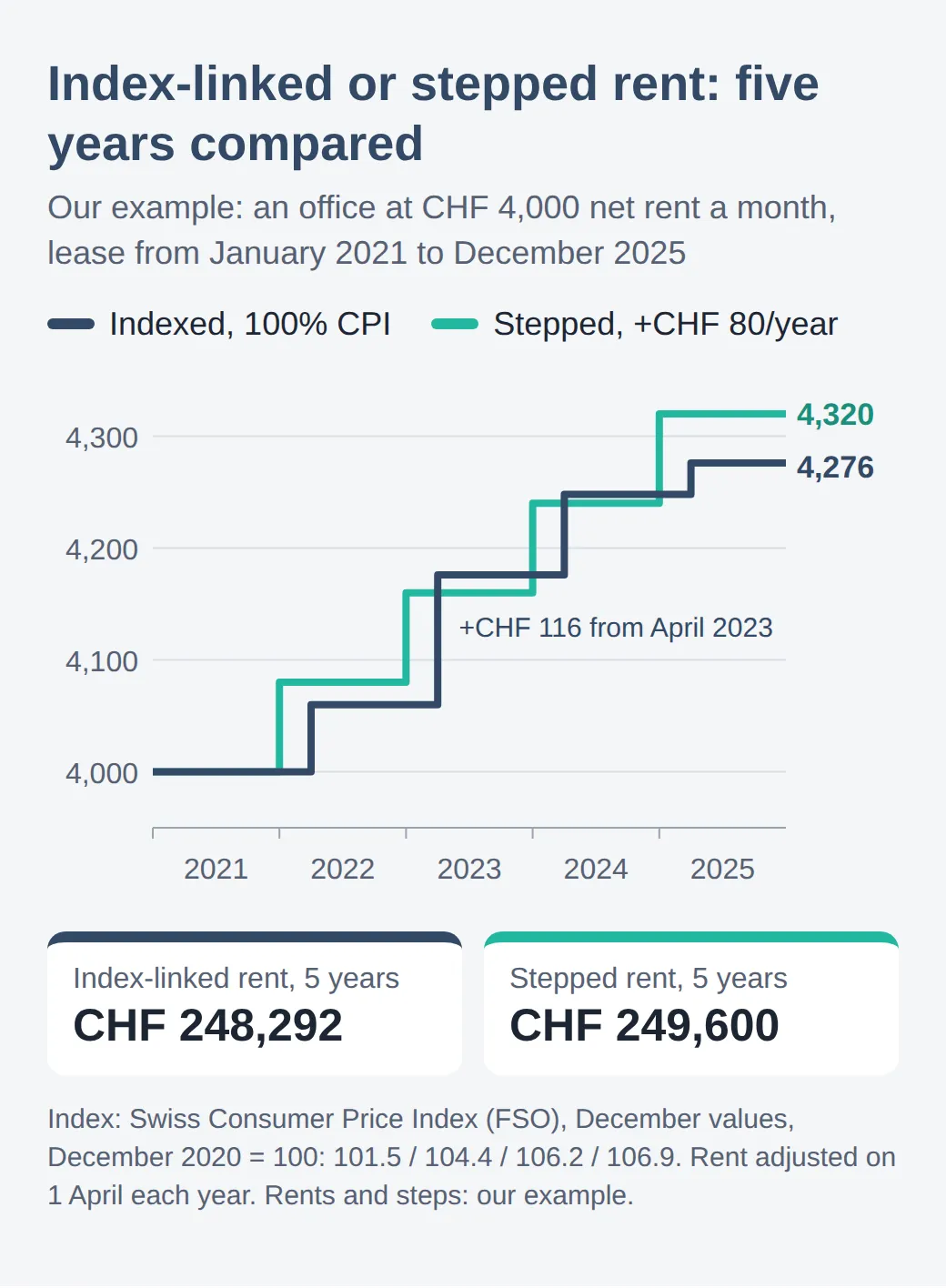
Over the full five years, the two end up almost level. The difference is the risk. The index-linked rent jumped by CHF 116 in April 2023 because inflation was high in 2022, and in 2025 it barely moved. Steps are predictable, even if inflation turns out lower than expected. With an index-linked rent, you carry inflation. For flats, the ordinance says outright that the rent must come down when the index falls (Art. 17 VMWG). For commercial premises the text says no such thing, and that is exactly the gap the Effretikon draft exploits.
Two rules protect you with an index-linked rent. The landlord must announce every adjustment on the official form, no earlier than the publication of the new index figure, and with at least 30 days' notice to the end of a month (Art. 17 and 19 VMWG). And before the conciliation authority, the only argument left is that an increase does not match the index (Art. 270c CO). A stepped rent cannot be challenged at all, only the initial rent (Art. 270d CO). Both also cut you off from a reduction when the reference interest rate for mortgages falls, which the Federal Office for Housing publishes every quarter (page in German, French and Italian).
Effretikon shows what to look for in the small print. The rent is "100.00% indexed", it can be adjusted twice a year, and: "A rent below the initial net rent set at the start of the lease is ruled out." That is an index that only works upwards. The law does not say expressly whether such a floor holds in a commercial lease, and that is not a dispute you want to start once the index falls. Strike the floor before you sign, so the index works both ways. Also in the draft: increases for additional services by the landlord ("Mehrleistungen") are possible even during the fixed term. Ask what that covers, because the draft defines it very broadly.
Service charges: only what the lease lists
You owe service charges (Nebenkosten) only where they are specifically agreed (Art. 257a CO). Anything the lease does not list is included in the rent. The landlord may charge the actual costs, such as heating, hot water and similar operating costs, and you have the right to see the receipts (Art. 257b CO). A landlord who bills payments on account must draw up a statement at least once a year. A flat rate must be based on a three-year average, and for preparing the statement the management may charge a fee based on the work involved or on usual rates (Art. 4 VMWG).
For commercial space, the list is often longer than for a flat. The Effretikon draft names heating, water and caretaking, but also the maintenance of ventilation, cooling and air conditioning, service contracts for passenger and goods lifts, lifting platforms and gates, and the fire alarm system. Electricity and gas used in the premises are paid by the tenant on top. Then there is a management fee, its rate left blank in the draft. The CHF 750 on account comes to just under 10 percent of the net rent. Whether that is enough, you will only see with the first statement.
Two more clauses from the draft are worth knowing. The statement is "deemed approved" unless you object in writing within 30 days. And the payments on account can be adjusted during the fixed term with one month's notice. If the landlord wants to introduce entirely new service charges during the lease, they need the official form, and you can challenge it within 30 days (Art. 269d and 270b CO). If there were previous tenants, ask for the statements of the last few years before you sign. And if other units in the building stand empty, the landlord pays their heating (Art. 7 VMWG).
Fit-out and restoration: settle it before you move in
What you must do with your fit-out at the end is decided when you sign, not when you move out. You may alter the premises only with the landlord's written consent (Art. 260a CO). Once they have consented, they can require you to restore the original state only if that was agreed in writing. And if the premises are worth considerably more at the end thanks to your work, you can claim compensation matching that added value.
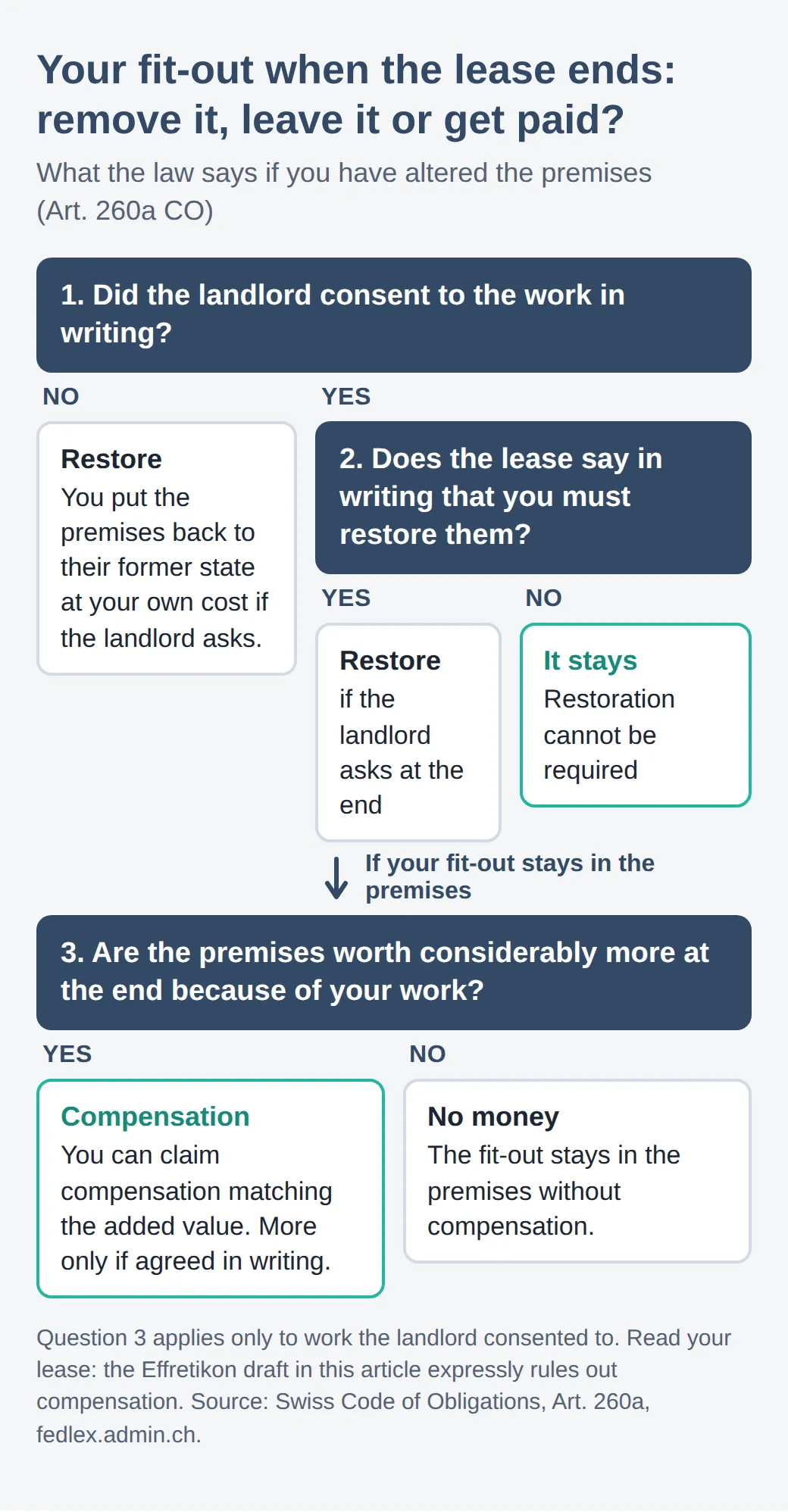
The Effretikon draft uses this leeway to the full. The space must be handed back at the end in a fully fitted-out state ("Vollausbau"). The landlord can demand that all tenant fit-outs be removed. If they waive that, the fittings stay in the premises, and there is "no entitlement to compensation, even if the tenant's fittings left in the premises might represent added value". The tenant pays for minor repairs up to CHF 500 per case.
The reverse case is worth a closer look. The landlord built the full fit-out at the town's request and spreads its cost into the rent over 20 years. If the town does not take up the option and leaves after ten years, it pays the residual value: CHF 100,000. So the option is not free here. It is the price of the landlord investing up front. With any offer where the landlord does the fit-out, check whether a clause like this is in it.
When you move out, you return the premises in the condition that follows from using them as the lease provides. A lump sum agreed in advance that covers more than the actual damage is void (Art. 267 CO). The landlord must inspect the premises at handover and report defects immediately; otherwise they lose their claims for anything a normal inspection would have revealed (Art. 267a CO).
Deposit: no cap, but a blocked account
For flats, the deposit is capped at three months' rent; for commercial premises it is not (Art. 257e CO). The amount is up for negotiation. HEV Region Winterthur says six to twelve months' rent is usual. Effretikon asks for CHF 21,000, about 2.75 months' net rent.
What is not negotiable: a deposit in cash or securities must be held by a bank in a savings account or securities deposit in your name. The bank releases it only with the consent of both sides or on the basis of a final payment order or court decision. If the landlord has not brought a legal claim within one year of the end of the lease, you can reclaim the money from the bank yourself. You do not have to accept an account in the landlord's name or a cash payment.
As alternatives to a cash deposit, HEV Region Winterthur lists among others a bank guarantee, a surety and rent deposit insurance. With insurance, you pay a premium every year, and if there is a claim, the insurer recovers the money from you. The Swiss Tenants' Association (page in German) advises tenants of flats against it for that reason. For a company with tight cash flow, the sums can look different once the deposit runs to six figures. Compare the premium over the whole term with the interest you would pay on a loan.
Getting out early: transfer, replacement tenant, sublet
If you want to leave commercial premises before a fixed term is up, you have three routes. The first exists only for commercial premises: you transfer the whole lease to a successor (Art. 263 CO). The landlord must consent in writing and may refuse only for good cause. The successor takes over the lease as it stands. You remain jointly and severally liable until the lease ends or could have been terminated, but for no more than two years. This is the route you take when, say, you sell a café or a shop with its fittings.
The second route is a replacement tenant: you hand the premises back early and propose someone solvent who will take over the lease on the same terms and whom the landlord can reasonably accept (Art. 264 CO). Without one, you pay until the next date on which the lease ends or can be terminated. The third route is subletting, all or part of the space (Art. 262 CO). The landlord must consent and may refuse only if you will not disclose the terms, the terms are unfair, or the sublet causes them major disadvantages. You remain the tenant and are liable for the subtenant using the premises only as you yourself may.
The Effretikon draft shows what landlords ask for on a transfer: proof of solvency from a bank, the last three years' balance sheets, extracts from the debt enforcement register and a new deposit. The draft forbids "key money" for the transfer with nothing given in return. If the landlord finds out later, they may terminate the lease and claim a contractual penalty of at least six months' rent. Work out early what you can charge your successor for fittings and fit-out.
Lease extension: up to six years, if you meet the deadline
If the end of the lease would cause your business hardship that the landlord's interests do not justify, you can ask for an extension (Art. 272 CO). For commercial premises, up to six years is possible, in one or two steps (Art. 272b CO). The authority weighs, among other things, how long you have been there, the local market for commercial premises and whether the landlord urgently needs the space for themselves.
The deadlines decide everything (Art. 273 CO). After notice of termination, you file your request with the conciliation authority within 30 days of receiving it. With a fixed-term lease, no later than 60 days before it expires, even if nobody has given notice. A second extension must be requested no later than 60 days before the first one ends, and the authority then checks whether you have done everything reasonable to find new premises. For Effretikon, that would mean: a tenant who missed the option must file 60 days before 30 September 2036, so by early August.
An extension is ruled out, among other cases, after termination for rent arrears and for leases expressly concluded only until planned renovation or demolition work (Art. 272a CO). If you are offered a cheap interim use, look for exactly this clause. Conciliation proceedings carry no court costs (Art. 113 CPC), and besides the chairperson, representatives of both sides sit on the authority. The Federal Office for Housing describes how the conciliation authorities work (in German, French and Italian).
What to negotiate before you sign
A commercial lease is an offer, not a form. The points that weigh most are nearly always the same:
- Option: genuine rather than non-genuine, with a fixed rent or a clear formula, and a deadline you can meet.
- Rent: an index without a floor, or steps you can afford, and a narrow definition of "additional services".
- Fit-out: who pays for what, whether restoration can be demanded, and whether added value is compensated. Have the condition at handover recorded with photos and a report.
- Service charges: a complete list, the rate of the management fee, statements from previous years.
- Deposit: amount and form, for example a bank guarantee instead of cash.
- Exit: transfer and subletting without extra hurdles beyond what the law sets.
- Floor area: in the Effretikon draft, a different floor area has no effect on the rent. If you pay per square metre, have it measured or strike that sentence.
Also read what the lease says about the place of jurisdiction and the address for notices, and who signs for your company. If your GmbH or AG is renting, only the company should be named in the lease, not you personally; otherwise you are personally liable, with your private assets at stake.
If you are looking for space now
With these points in mind, you read a listing differently: at every viewing, ask about the term, the option, the type of rent and the standard of fit-out before you talk about colours and light. Offices in the canton of Zurich, where Effretikon is, are listed here:
If you need a workshop, studio or shop, you will find commercial and industrial space in Zurich, for example:
And if you only need storage space, have a look at storage rooms in Bern or in Basel. What comes next: the Federal Council wants to set out more precisely how the permitted return is calculated under tenancy law. The consultation (page in German, French and Italian) ran until June 2026, and the ordinance also applies to commercial premises. Nothing has been decided yet. For a lease you sign now, the rules above count, and above all what you negotiate into it.
Common questions
Does the six-month notice period also apply to a storage unit or a parking space?
For a storage room you use for your business, usually yes. The law does not define commercial premises. The common description, used for example by the landlord association HEV Region Winterthur, counts any space the lease dedicates to a trade or profession, a warehouse or workshop included. A parking space rented separately from the premises is different: it can be terminated with two weeks' notice to the end of a one-month period, unless the lease sets a longer period.
Can I get a rent reduction on a commercial lease when the reference interest rate falls?
It depends on the kind of rent you have. With an ordinary rent, yes: you ask in writing and the landlord has 30 days to reply. If they refuse or stay silent, you can go to the conciliation authority within a further 30 days. With an index-linked rent only the index counts, a stepped rent follows the agreed steps, and the reference rate does not help with either.
Can a landlord in Switzerland terminate a commercial lease by email?
No. For commercial premises the landlord must give notice in writing on a form approved by the canton. Without that form, the termination is void. You give notice yourself with a signed letter and need no form.
How do I get my rent deposit back if the landlord does not respond after I move out?
If the landlord has not brought a legal claim against you within one year of the end of the lease, you can ask the bank to pay the money back to you directly. Before that, the bank releases the deposit only with the consent of both parties or on the basis of a final payment order or court decision.
Does it cost anything to go to the rent conciliation authority?
No court costs are charged in conciliation proceedings over residential or commercial premises, and no party costs are awarded. If you hire a lawyer, though, you pay their fees yourself. Besides the chairperson, the authority includes representatives of both tenants and landlords.